If you’ve ever wondered what to put on a charcuterie board, you’re not alone. But creating the perfect charcuterie board is much easier than it looks. This step-by-step guide will show you exactly what to put on a grazing board and how to build it so it looks amazing – even if you’re a beginner!
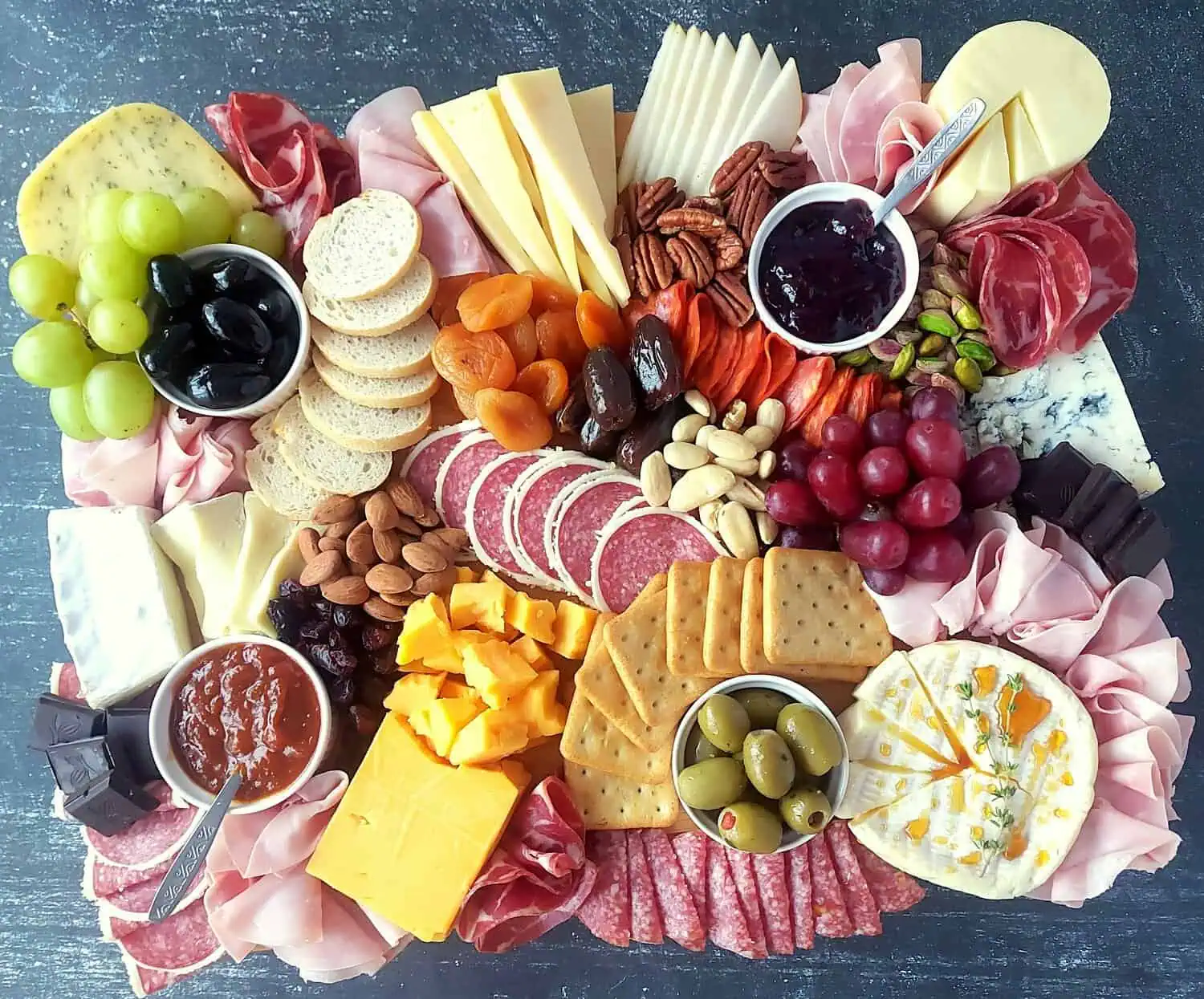
Charcuterie boards are all about bringing people together around great food and are one of the most popular and beautiful ways to entertain, whether you’re hosting a dinner party, holiday gathering, or casual wine night at home. They are a great way to serve a beautiful appetizer with a variety of flavors, and they’re just as fun to make as they are to eat.
What Is a Charcuterie Board?
The term charcuterie (‘shahr-koo-tuh-ree’) is a French term referring to the culinary practice of curing and preserving meat. The term is derived from the French words ‘chair‘ (meat) and ‘cuit‘ (cooked).
Charcuterie began in 15th-century France as a necessity to preserve meat products through salting, curing, and smoking. Because refrigeration did not exist, these preservation methods were essential, allowing meat to be stored for extended periods.
Over time, this practice evolved and was refined in France and the Iberian Peninsula. Spain also has a rich cured meats heritage, with iconic examples like jamón ibérico and chorizo that are often part of charcuterie platters alongside French favorites.
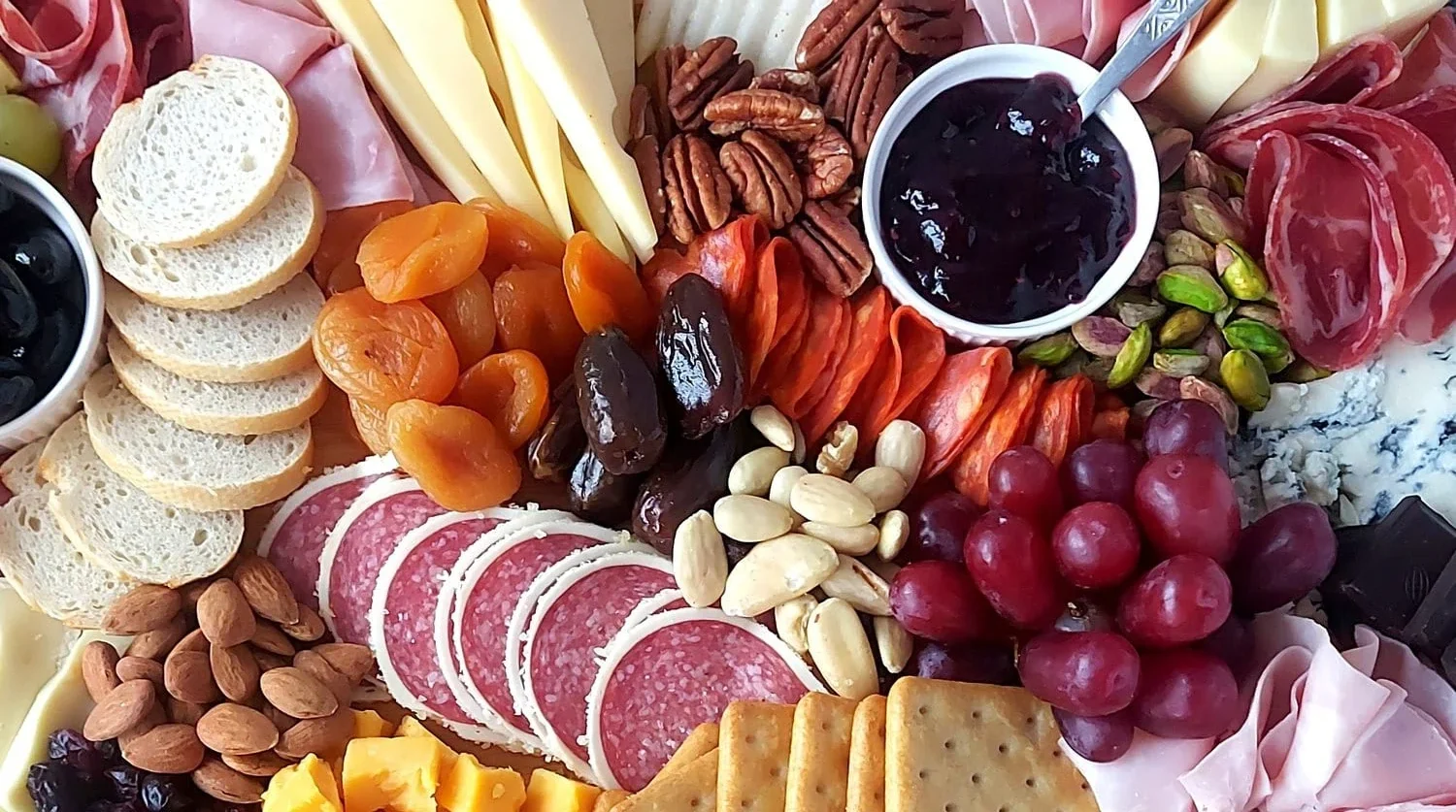
Nowadays, ‘charcuterie’ refers to the art of preparing beautiful boards and the artfully arranged and visually stunning platters that include a variety of cold cuts, cured and aged meats, a variety of cheeses, fruits, nuts, crackers, and tasty spreads. Even though the word ‘charcuterie’ technically refers just to the meats, the modern charcuterie board has become a super-popular appetizer, a snack board designed for sharing and grazing with friends, making it perfect for parties, holidays, or casual get‑togethers.
Why I Love Charcuterie Boards
As someone who regularly builds boards for family gatherings and dinner parties, I can confidently say that a beautiful charcuterie spread is just as eye-catching as it is delicious. It is always a show-stopper, it wows guests, and compliments are always flowing (who doesn’t like that?!). And the best part is, a successful charcuterie board doesn’t have to be complicated! With the right balance of flavors, textures, and colors, you can create a stunning grazing board that feels abundant, impressive, and tastes even better!
There is an art to preparing beautiful boards. In this step-by-step guide, I will teach you the core elements you need to know to assemble your own charcuterie board that will impress your guests! From what to include, the assortment of meats and types of cheese, to fruits, crunchy carbs, and finishing touches. And also a few styling tips so your board looks as stunning and impressive as it tastes!
And if you’re serving your charcuterie board as part of a larger spread, pair it with my Deviled Eggs Recipe with Bacon (Unexpected Twist!) for an easy appetizer combo, then add a show-stopping main like my Cranberry Apple Stuffed Pork Loin (Festive & Refined) to turn it into a complete holiday-style meal.
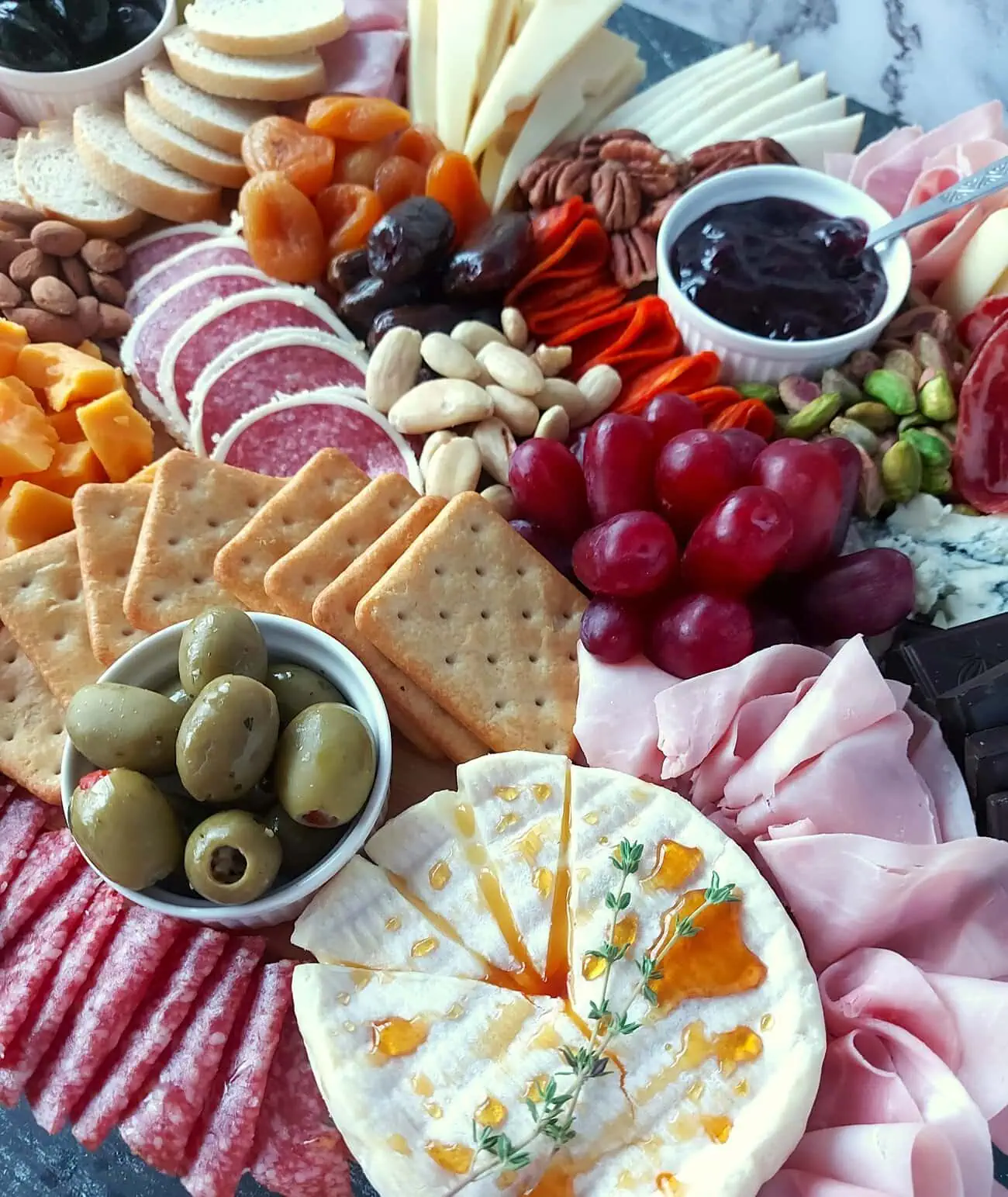
Charcuterie Board Essentials
You don’t have to be a pro to make a stunning charcuterie board. But there are a few tips and tricks that you should know about.
My best advice? Think in categories! It keeps everything simple and organized.
Here’s a quick look at the main categories you’ll want to include on your charcuterie board, for a clear overview:
1. CHEESES
- Soft and spreadable
- Semi-soft
- Hard
- Bold, funky, blue
2. MEATS
- Salami
- Sausage
- Chorizo
- Ham
- Aged and cured meats
3. FLAVOR BOOSTERS
- Spreads, dips, sweet touches, and condiments
- Pickled and briny items
4. CRACKERS, BREADS & CRUNCHY CARBS
- Crackers
- Crusty bread
- Breadsticks
- Crostini
5. FRESH & DRIED FRUITS
6. NUTS, SWEETS & FINAL TOUCHES
Use this as a guide and starting point. Feel free to tweak, swap, and adjust based on your personal preference, what you have on hand, the tastes of the guests you’re serving, and the occasion. And have fun with it!
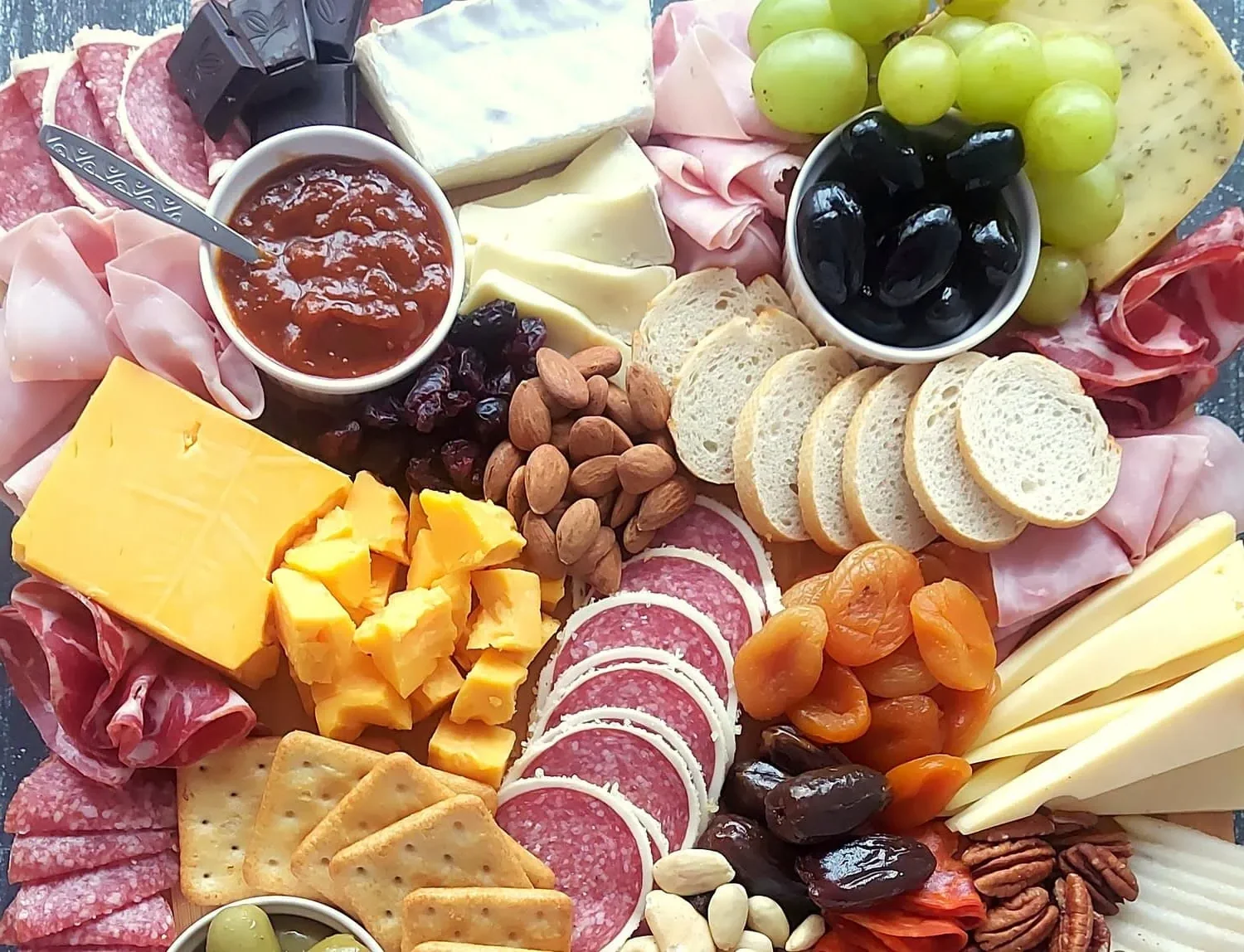
Charcuterie Board Ingredients, Explained
Now that you’ve got the overview, let’s go through each category and break it down step by step.
1. CHEESES (Creamy, Firm, and Everything In Between)
Cheese is the star of the board, so aim for a mix of different types of cheese, depending on budget and occasion. This variety of cheeses ensures there’s a kind for everyone.
Soft and spreadable cheeses
- Brie or Camembert – buttery, ripe, oozy
- Goat cheese (Chevre) – tangy, plain, or herb-coated
- Boursin – creamy, soft, spreadable, Garlic & Fine Herbs flavor, but also Pepper or Shallots & Chives
- Burrata – fresh mozzarella with a creamy centre
- Plain cream cheese – for less adventurous guests, can be topped with honey, jams, or fruit preserves
Semi-soft cheeses
- Havarti – creamy, mild
- Gouda – creamy, mild when young; richer, nuttier, more granular as it ages
- Edam – mild, lightly salty, firm but creamy, often with a springy feel
- Drunken goat cheese – mild, fruity, tangy with sweet, wine-infused notes (soaked in red wine during aging)
- Muenster – mild, buttery, slightly tangy
- Fontina – mild, buttery; richer, more pungent notes as it ages
- Monterey Jack – mild, buttery, slightly sweet, with a creamy texture
- Pepper Jack – creamy, buttery, smooth, with flecks of spicy peppers (jalapeños, habaneros, etc.), with a fiery kick ranging from mild to hot
Hard cheeses
- Parmesan – rich, complex, savory, salty, granular, crumbly texture with crunchy crystals
- Pecorino Romano – bold, salty, sharp, slightly grassy bite, intense flavor
- Aged Cheddar – rich, deeply savory, firm texture; develops sharp, tangy notes (I recommend sharp white or Unexpected Cheddar from Trader Joe’s – this one is a blend of aged Cheddar and Italian Parmesan. It has a sharp flavor, crumbly, with salty crystals. It tastes like a mature Cheddar evolving into a Parmesan as you eat it.)
- Manchego – buttery, smooth, mild sweetness; earthy, nutty flavors that become more pronounced as it ages
- Aged Gouda – complex, toasty flavors, nutty with a hint of sweetness, it has a firm, slightly crumbly texture
- Gruyère – rich, creamy, sweet, and nutty, with a dense, slightly grainy texture when aged
Bold, funky blue cheeses
- Gorgonzola – creamy, bold, tangy; smooth texture that melts on the palate; ranges from mildly sweet to sharp, depending on age
- Stilton – rich, deep savory flavors, lingering, robust finish, slightly crumbly texture
- Roquefort – intensely bold, salty, sharp, tangy, creamy yet crumbly texture; distinct earthy depth that makes it a standout blue cheese
- Maytag Blue – rich, tangy, smooth, slightly crumbly texture, sharp but well-balanced, with a clean, lingering finish
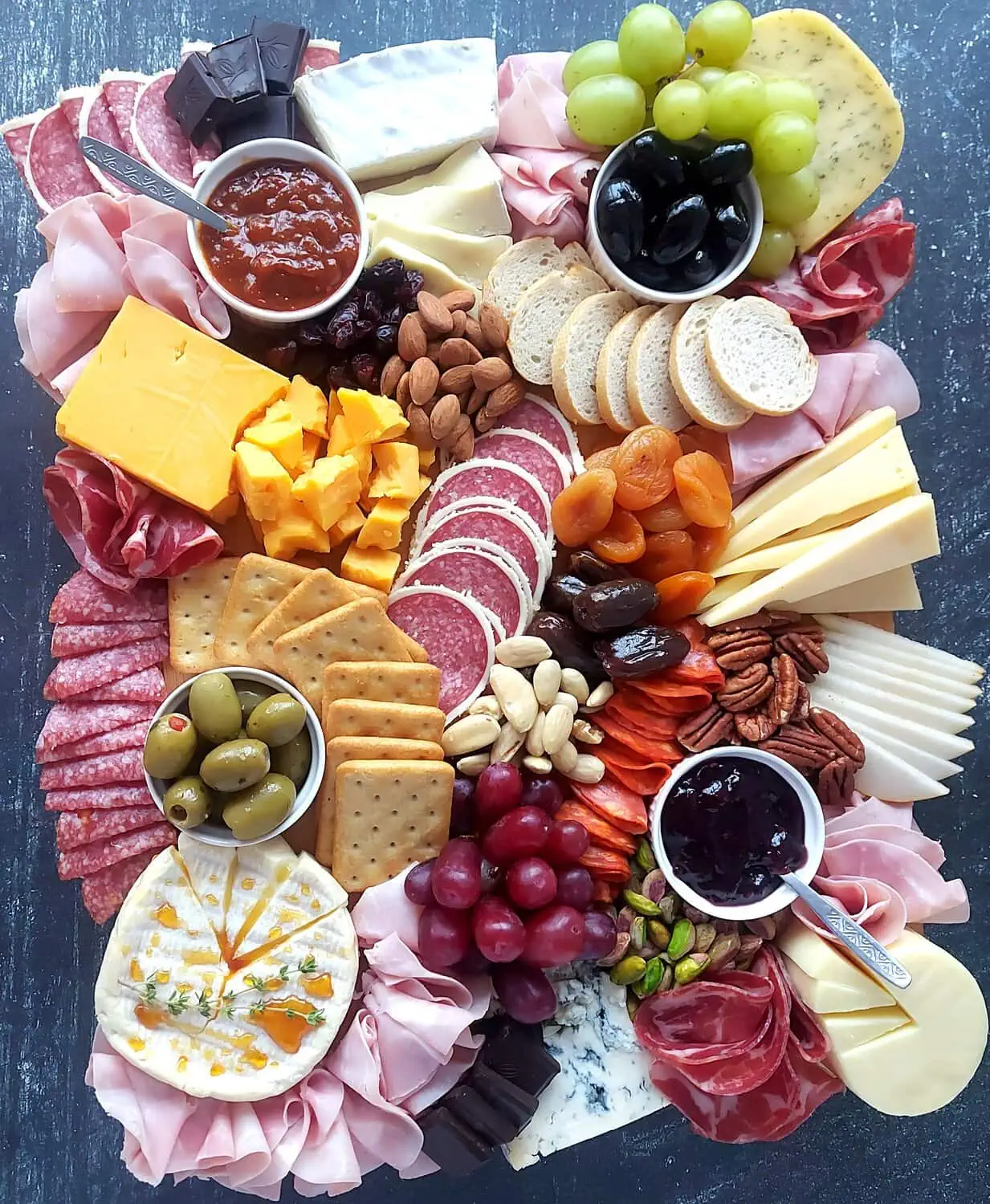
2. MEATS
A good board includes a variety of meats with different flavors and textures.
Combining familiar cold cuts with a slightly fancier meat creates interest without overwhelming your guests. Most of these can be found in the deli section, making it easy to mix and match. Popular types of meats include:
- Genoa salami – mild, tangy, rich flavor with notes of garlic, black pepper, and red wine, and a soft, tender, slightly moist, and greasy texture
- Hard salami – bold, savory, pungent, often smoky flavor, notes of black pepper, garlic, and sometimes red pepper flakes, with a firm, dense, slightly chewy texture
- Spicy salami – bold, savory, tangy, medium to hot piquant flavor, with a firm, dense, often chewy texture
- Chorizo – bold, dry-cured, spicy/smoky from paprika, garlic, and chili, with a firm texture
- Cured meat or aged meats – Prosciutto (mild, sweet, delicate, soft), Serrano ham (more intense, firmer, good bite), or Jamón Iberico (complex, rich, buttery, melt-in-your-mouth, with umami notes)
- Summer sausage – mildly tangy, savory, often smoky, hints of garlic and mustard, with a moist, firm yet tender, and smooth texture
3. FLAVOR BOOSTERS
Spreads, Dips, Sweet Touches & Condiments
Spreads add contrast and bring the whole board to life. Include a mix of:
- Sweet jams or spreads – apricot preserves, strawberry jam, blueberry jam, fig jam, fig chutney, orange marmalade, quince paste, pepper jelly, balsamic glaze, etc.
- Spicy mustard, spicy jelly, or a spicy spread – can be finished with red pepper flakes
- Savory spreads – hummus, olive tapenade, pâté, rillette, whipped feta, pesto, olive oil, and balsamic vinegar
Pickled & Briny Items
Briny bites cut through the richness of the cheese and add brightness. The bold flavors balance creamy cheeses and cured meats beautifully. So, add at least one of the following:
- Olives – add a mix of different varieties – green, black, red – marinated in herbs and oil, or stuffed with garlic, pepper, sun-dried tomatoes, cheese, etc.
- Cornichons – tart gherkin pickles are a classic charcuterie board addition and pair well with rich meats like prosciutto and pâté
- Dill pickles – garlicky tang
- Pearl onions – pickled or glazed, a tangy, sweet, or savory pop of flavor, complementing the rich flavors on the cheese board
- Pickled red onions – sweet, tangy, with a vibrant pop of color
- Pickled bell peppers or red peppers – sweet, tangy, add great flavor and beautiful color
- Artichoke hearts – marinated artichoke hearts add a soft, savory element that pairs well with many cheeses
- Capers – sharp, briny kick
4. CRACKERS, BREADS & CRUNCHY CARBS
Carbs are essential for building the perfect bite. The crisp exterior and chewy interior offer a satisfying contrast to soft cheeses and cured meats. Here are the types I use and recommend:
Crackers
Offer a mix of different types – neutral, savory, and sweet – to complement various meats and cheeses
- Water crackers – thin, crisp, flavorless, let the flavors of the meats and cheeses shine
- Table crackers – lightly flavored, pairing well with almost any topping
- Butter crackers – rich and buttery (like Ritz or Club crackers), providing the perfect contrast to sharp or salty cheeses
- Multigrain crackers – robust, nutty taste that pairs beautifully with aged Cheddar, Gouda, Parmesan, spicy salami; they also add variety and interest
- Whole wheat crackers – nutty, earthy, wholesome
Crusty bread
The crisp exterior and chewy interior of crusty breads offer a satisfying contrast to soft cheeses and cured meats.
- Baguette slices (fresh or toasted) – sliced straight or diagonally for more surface area
- Sourdough – tangy flavor, great texture, especially the seeded varieties
- Ciabatta – crispy crust, soft inside.
- Focaccia – crispy crust, soft, chewy inside; can have different flavors: rosemary, garlic, olives, caramelized onions, sun-dried tomatoes, etc.
- Raisin/cranberry bagel – sweet, subtly spiced, perfectly complementing soft, mild cheeses
Breadsticks
Breadsticks (like Grissini) add not only a satisfying crunch and texture, and a neutral base for meats, cheeses, dips, and spreads, but also visual appeal due to their height.
You can also wrap them in prosciutto for an extra touch.
Crostini
Lightly toasting crostini with olive oil (or truffle oil), a rub of garlic (or rosemary, thyme), and a sprinkle of sea salt enhances their flavor and crunch.
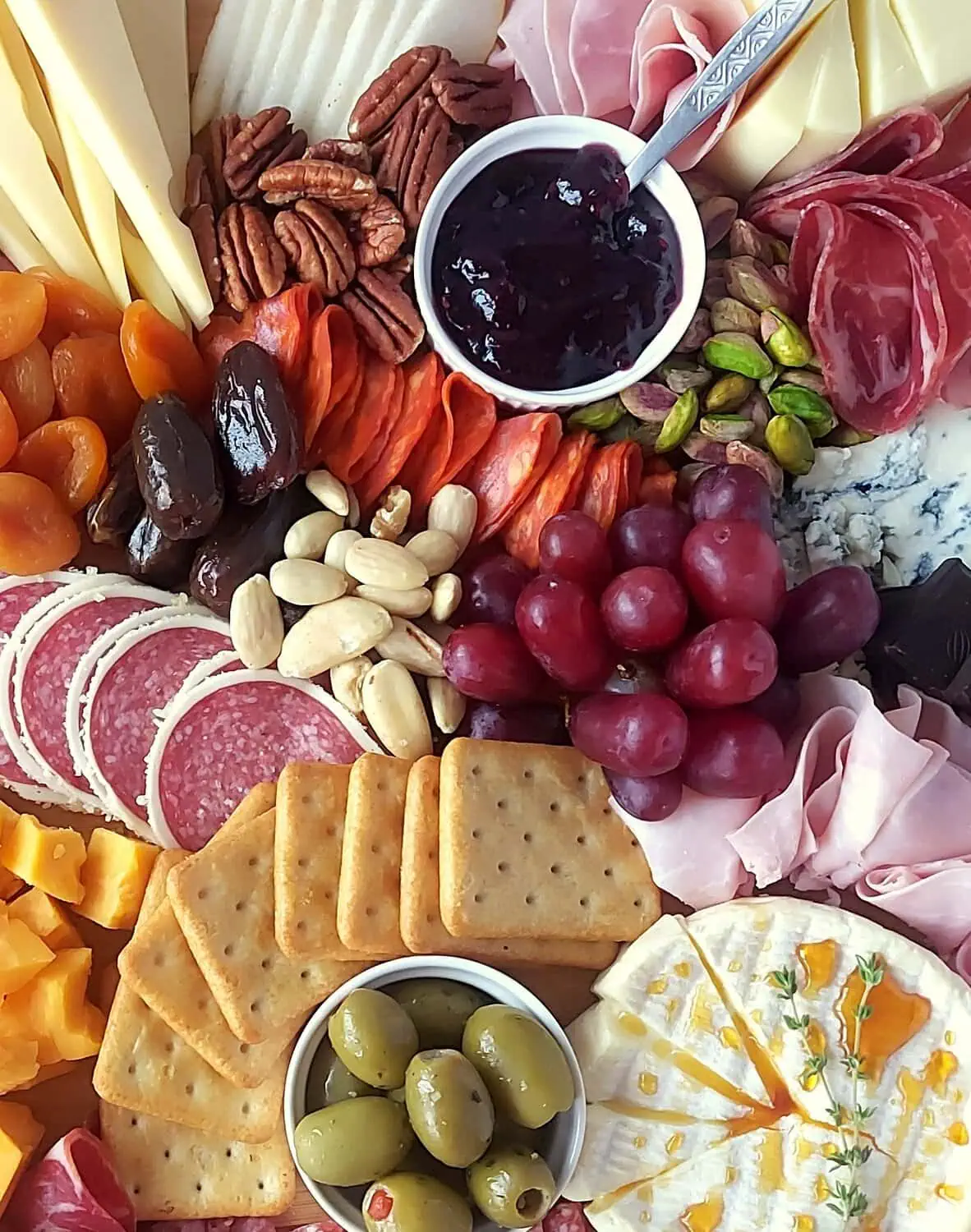
5. FRESH & DRIED FRUITS
Fresh fruit adds freshness and brightens the board, being perfect for cleansing the palate.
Dried fruit adds chewy texture and sweetness, balancing rich and aged cheeses.
Choose fresh fruits with varied colors (reds, greens, blues), textures (soft, crisp, juicy), and flavors (regular, tropical).
Prep ahead – wash the fruits and dry them. Slice fruits like apples, pears, mango, and kiwi just before serving to prevent browning. To keep sliced apples or pears from browning, soak them for about 5 minutes in cold water with a splash of lemon juice – 1 tablespoon per cup of water.
My go-to options always include some of the following:
- Fresh fruits: grapes (white, red, black), apple slices, pears, figs, raspberries, blueberries, strawberries, kiwi, melons, peaches, apricots, cherries, oranges, mango, pineapple, etc.
- Dried fruit: apricots, figs, dates, tart cherries, cranberries, raisins, mango, pineapple
6. NUTS & SWEETS
These smaller additions fill in the gaps and elevate the board. These last additions help tie everything together and make your board feel complete and intentional. Add:
- Nuts – almonds (I love Marcona almonds), cashews, walnuts, macadamia nuts, Brazilian nuts, peanuts, or mixed nuts
- Dark chocolate – one of my favorite things is to finish with a good quality dark chocolate (broken into pieces), at least 70% cocoa
7. FINAL TOUCHES
- Garnish with fresh herbs (rosemary, thyme, sage, basil sprigs)
- Use cheese knives, small spoons, or tongs for easy grazing
- Use cocktail picks or toothpicks
- Provide napkins and small plates
How Far in Advance Can You Assemble a Charcuterie Board
Many of the elements can be prepared 1-2 days in advance, which makes the party day much more relaxed.
You can slice hard cheeses, wash and dry fruit, portion nuts and dried fruit, and prepare dips ahead of time.
The board can be assembled up to a few hours before serving, then covered tightly and refrigerated. Take it out 30–60 minutes before guests arrive so cheeses can come to room temperature and taste their best. Items like crackers, sliced fruit, and delicate herbs should be placed last, right before serving, so everything looks fresh and crisp.
What Board Size or Shape to Choose
Boards should be chosen based on how many people you’re serving, how much food you’re offering, and the space you have available. Rectangular boards are great for variety and clean sections, while round boards feel cozy and informal.
Here’s a simple size guide you can follow:
5 guests: A board around 12 x 18 inches (30 x 46 cm) or a large round board, 14–15 inches (36–38 cm)
10 guests: A board around 16 x 24 inches (41 x 61 cm) or two medium boards
15 guests: A board around 18 x 30 inches (46 x 76 cm) or multiple boards spread out
20 guests: Use a large serving table, kitchen island, or several boards arranged together
How To Assemble a Charcuterie Board (Step-by-Step)
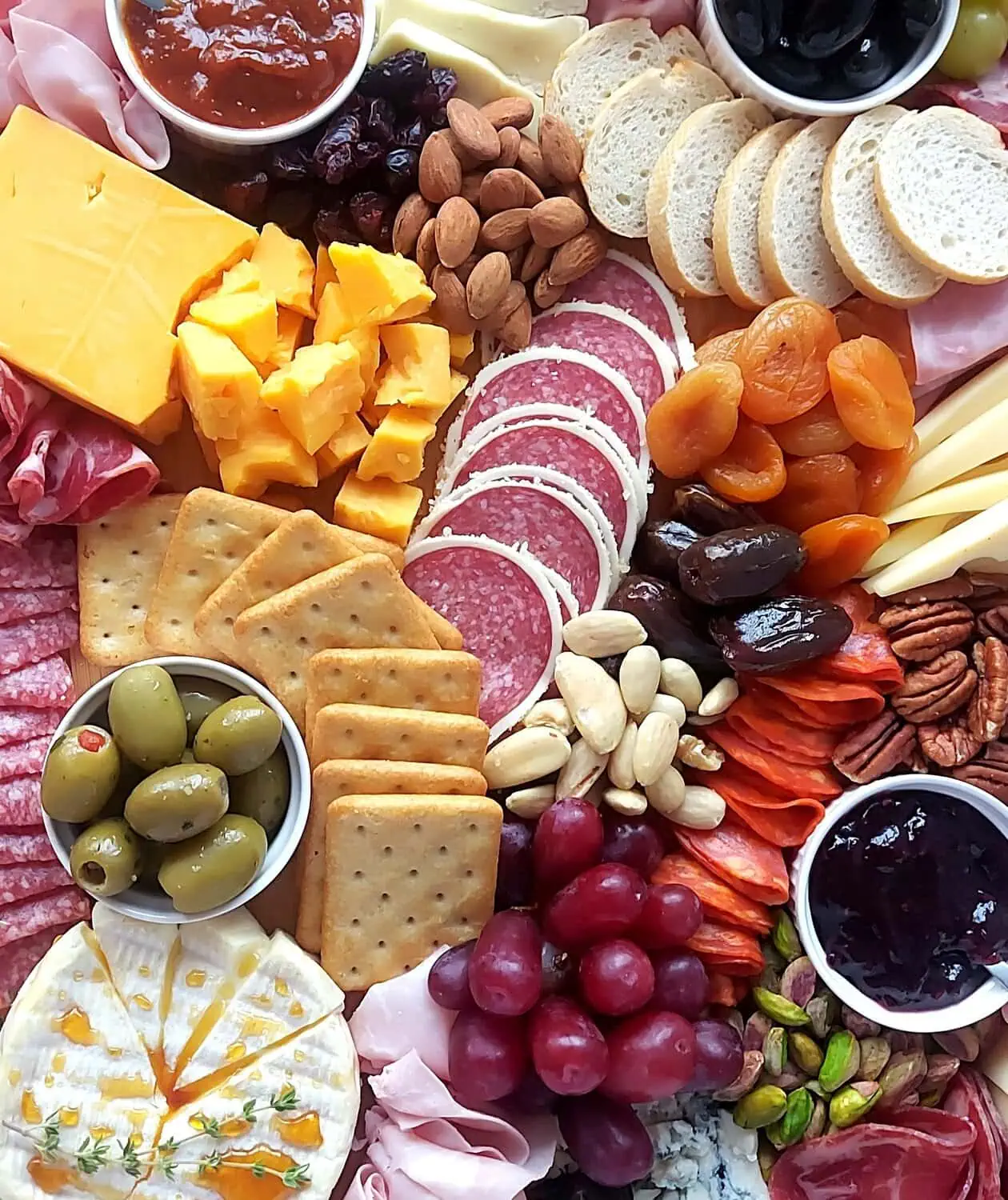
Now that you know what goes into a great board, let’s dive into how to assemble a charcuterie board step by step. Think of this as a helpful framework rather than a strict set of rules.
There’s one thing to keep in mind for building a stunning charcuterie board: variety is key! That means including a mix of:
- Flavors – sweet, savory, spicy, and funky
- Textures – smooth, creamy, and crunchy
- Shapes – rectangles, triangles (wedges), cubes, crumbles, and blocks
- Colors – think yellow, white, red, green, and blue
Step 1 – Select your board and ramekins
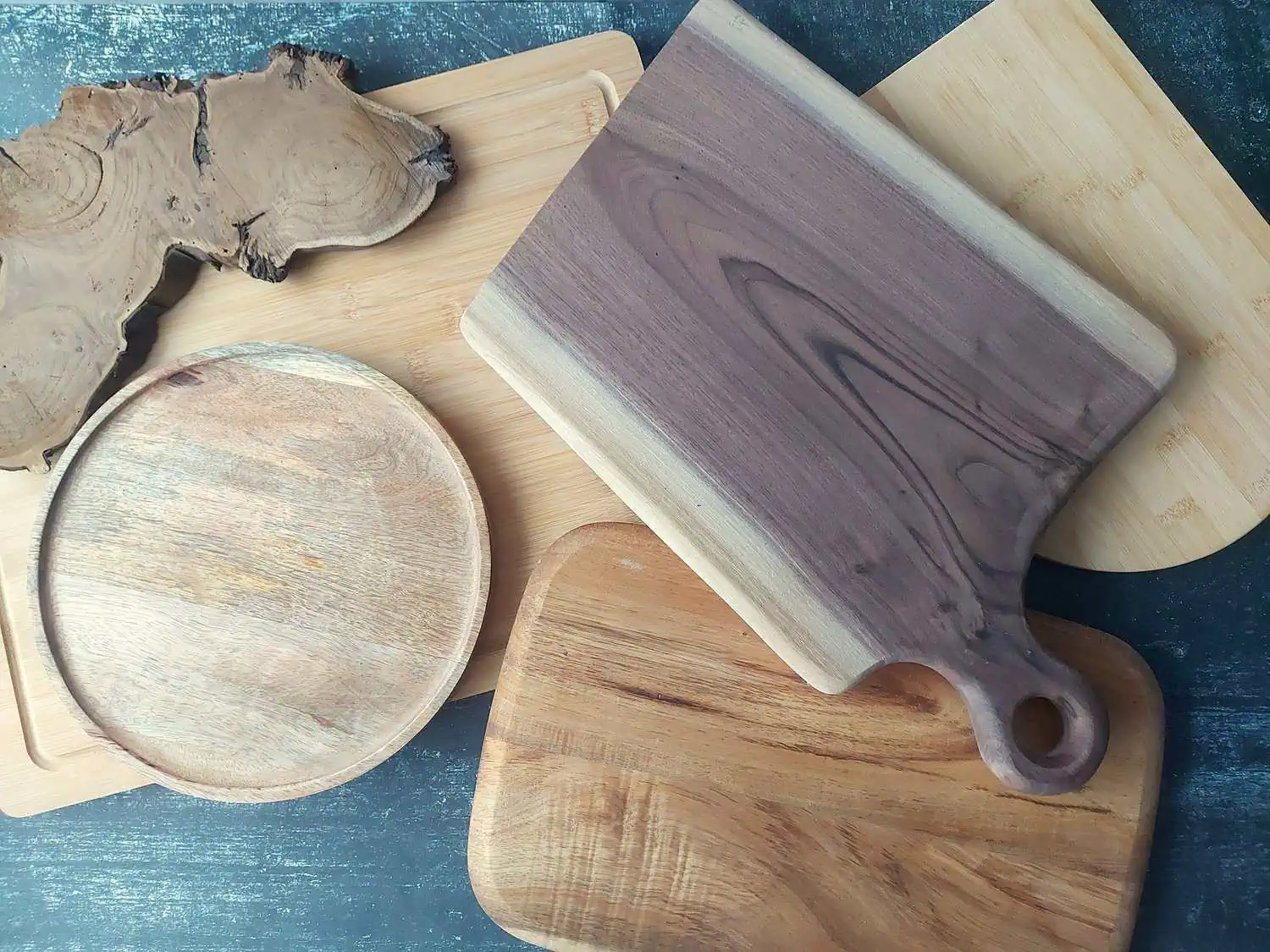
Depending on the number of guests you are entertaining, your personal preference, and the theme of your party, you might want to choose simpler or more sophisticated boards. You can go for wood, marble, slate, whatever you fancy. If you have a large crowd to feed, you can scatter several charcuterie boards around the room, or even use a table or kitchen island as your board, by simply laying down a large sheet of parchment paper or butcher paper and arranging the food directly on it.
You can find affordable charcuterie boards at Crate & Barrel, World Market, TJ Maxx/Marshalls, Costco, Etsy, NOVICA, etc.
When selecting a board, go for the ones made of hardwood, as they will not stain and won’t develop any odor over time. Such options include: hard maple, walnut, cherry, beech, teak, acacia, and bamboo. Try to avoid softwoods and open-grain woods, such as oak, pine, and cedar, as they can easily be damaged by knives and trap food and bacteria.
You will also need a few ramekins for serving the jams, dips, and pickled items.
Step 2 – Start with the Cheese
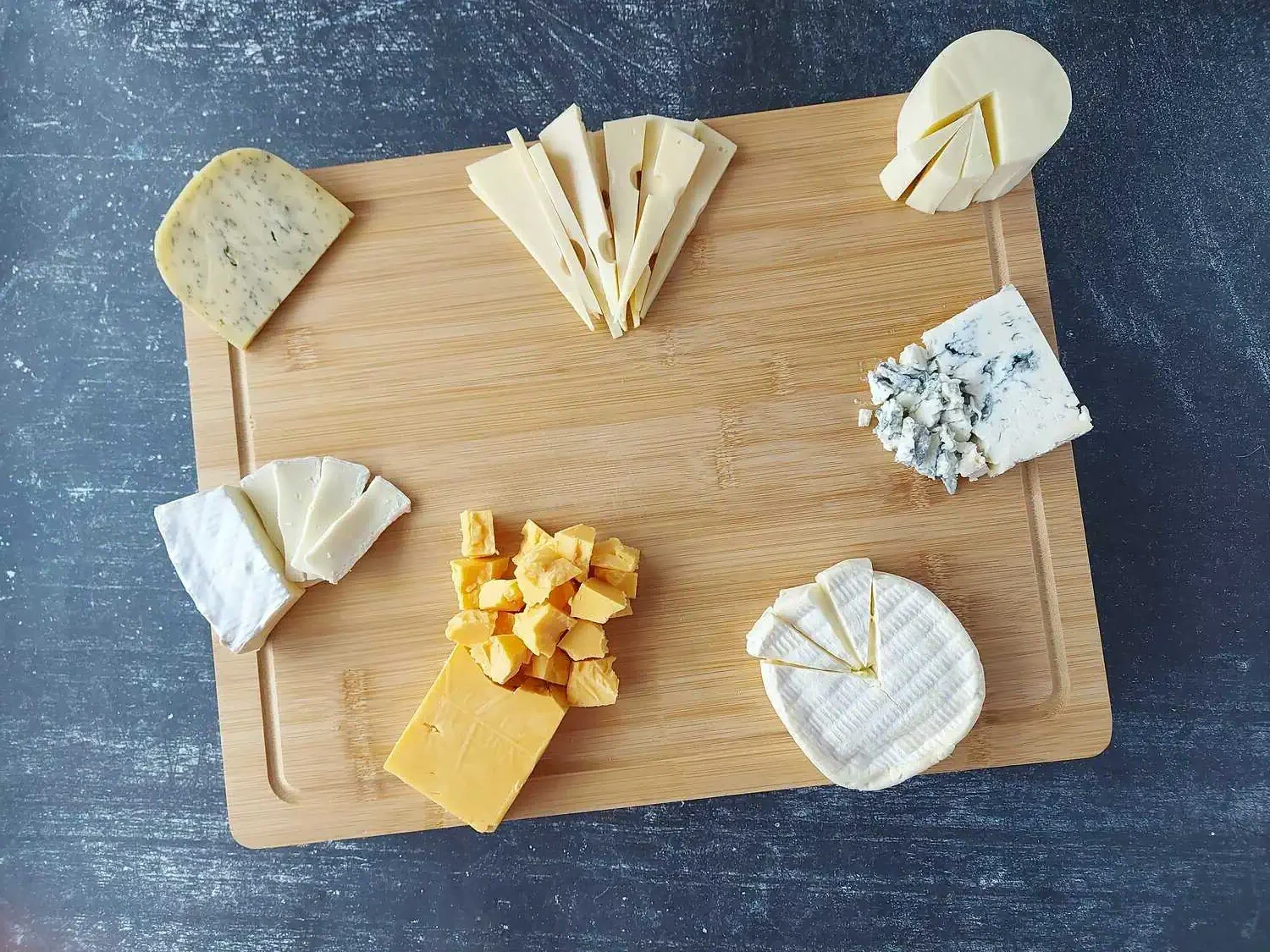
Cheese should be added first because it is always the star of the board, and it helps create a framework for arranging all the other elements.
A good rule of thumb is to choose an odd number of cheeses – usually 3, 5, or 7, depending on the size of your board and the number of guests.
Include at least one cheese from each category (use 1 soft /1 spreadable, 1 semi-soft, 1 hard, 1 funky cheese). If you choose two from the same category, ensure their flavor profiles are different (e.g., a mild cheese and a more tangy, garlicky, or bold one).
Cut the cheeses into different shapes – wedges, cubes, slices, crumbled, whole – but also leave the rest of the cheese block on the board. This adds visual variety and interest and makes the cheese plate more inviting. Plus, guests are more likely to dig in when the cheese is already pre-cut.
To ensure variety, try to aim for a variety of colors as well: white, yellow, red, herby green, and blue.
For extra visual interest, you can place a block of cheese (like blue cheese), along with some honey and nuts, on a small stand in one corner of the board. This adds height and helps the board really stand out.
Choose 2-3 oz (55-85 g) of cheese per person if served as an appetizer, or 4-5 oz (115-140 g) per person if it’s the main meal.
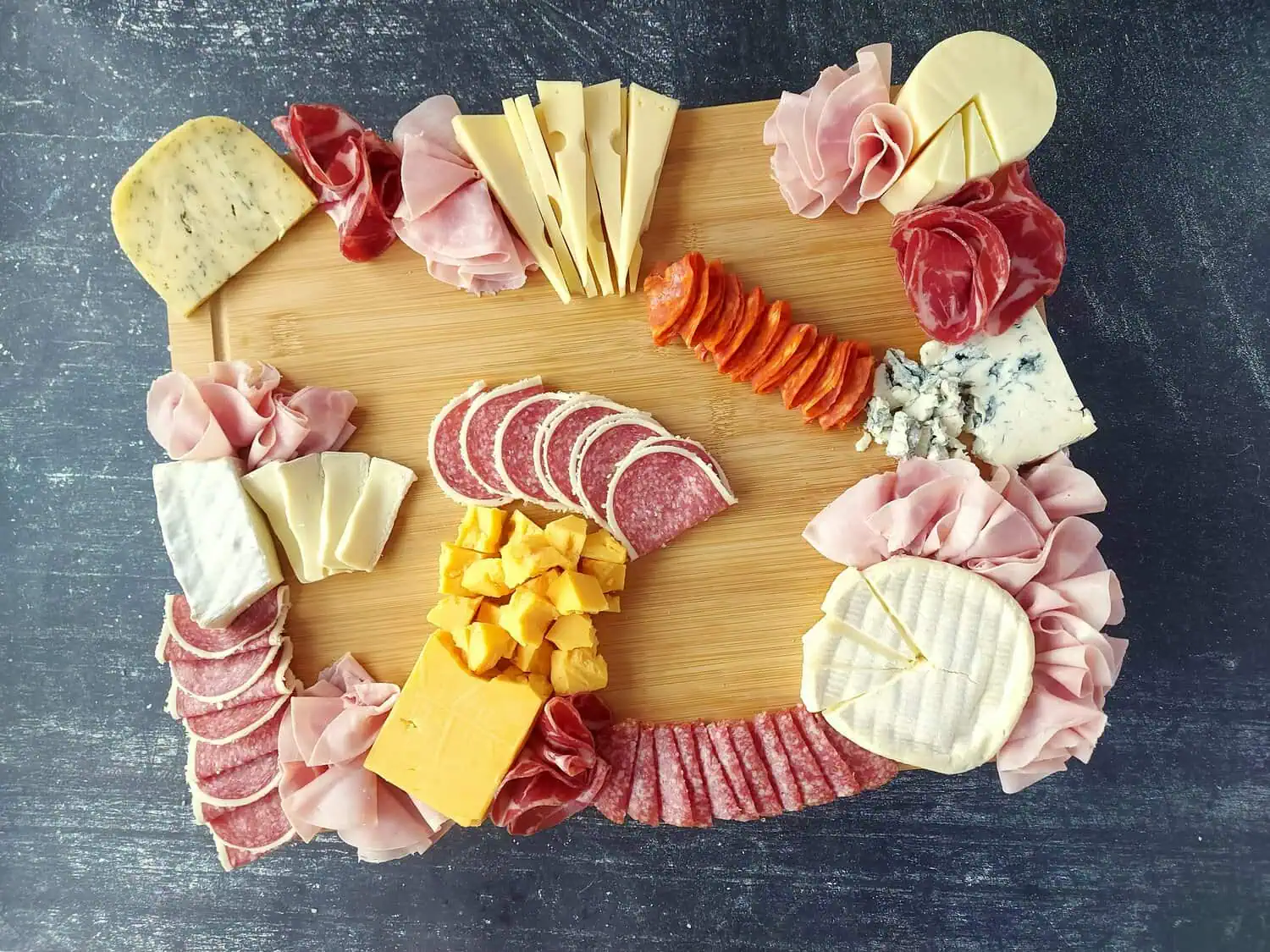
Step 3 – Add the meats
Fold, layer, or fan charcuterie meats and place them around the cheese in different areas of the board for balance and easy serving.
I like to use the meats to create almost a full border around the board, to keep the smaller items from spilling out.
Fold and arrange based on size. Leave small salami slices as they are and arrange them in an overlapping straight, wavy, or diagonal line, or fan them out like a deck of cards.
For larger slices, fold in half or quarters and place them either in a line or grouped in different areas of the board.
For very thin meats like prosciutto, ham, or bresaola, fold them into loose ribbons or flower shapes. To make ribbons, gently pick up one slice of prosciutto and loosely fold it back and forth into soft waves, almost like a ribbon. Let it fall naturally onto the board.
These relaxed folds create height, make it easy for guests to grab a piece, and look elegant, interesting, and fun.
Choose 2-3 oz (55-85 g) of meat per person if served as an appetizer, or 4-5 oz (115-140 g) per person if it’s the main meal.
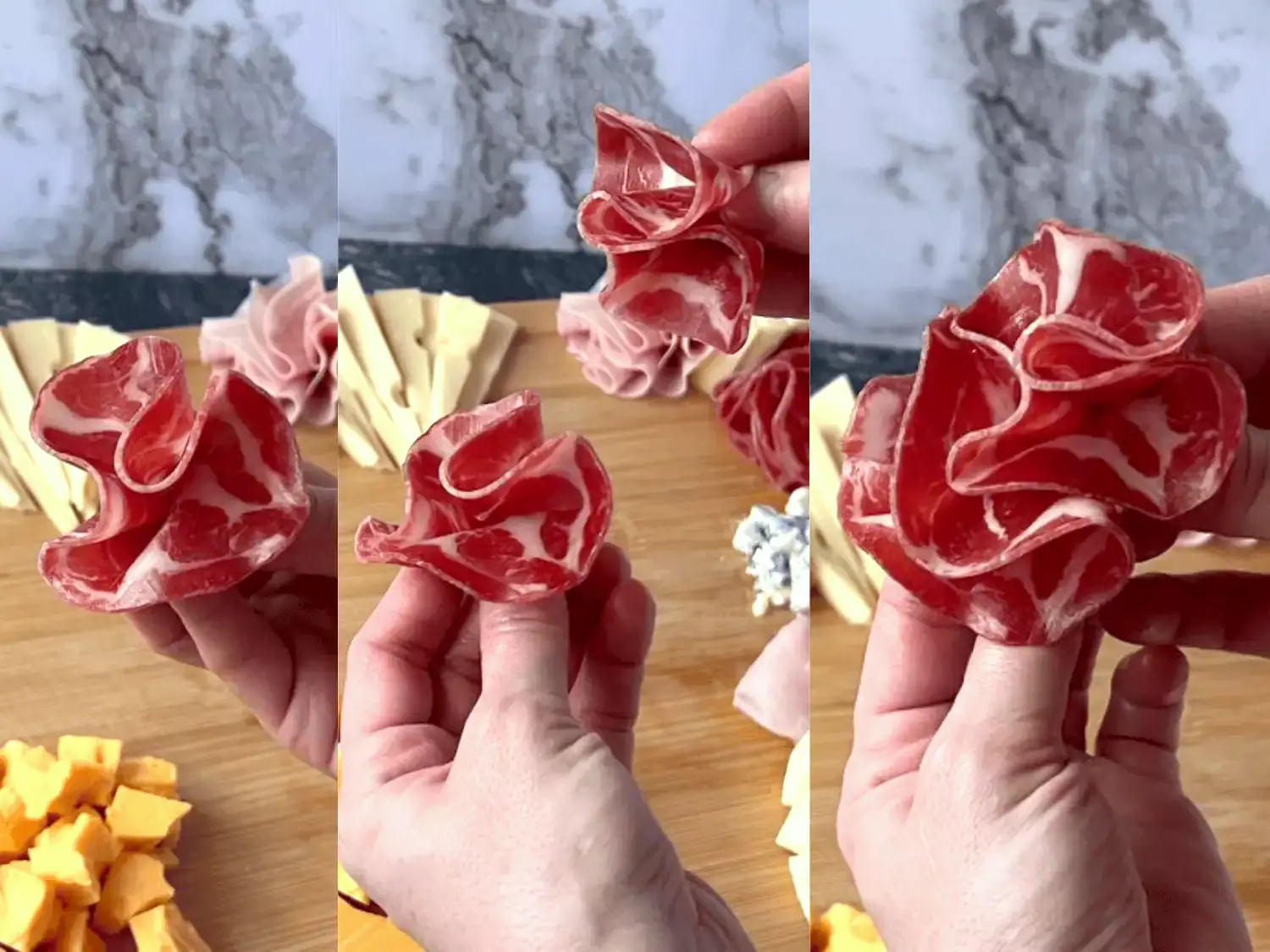
To make florettes, take a larger salami slice and pinch it in the center, bringing the outer edges together to form a flower shape. Hold it with one hand while shaping with the other. Pair two florettes together and place them next to a block of cheese on the board for support, so they don’t unfold.
Step 4 – Arrange the flavor boosters: spreads, dips, jams, pickled items
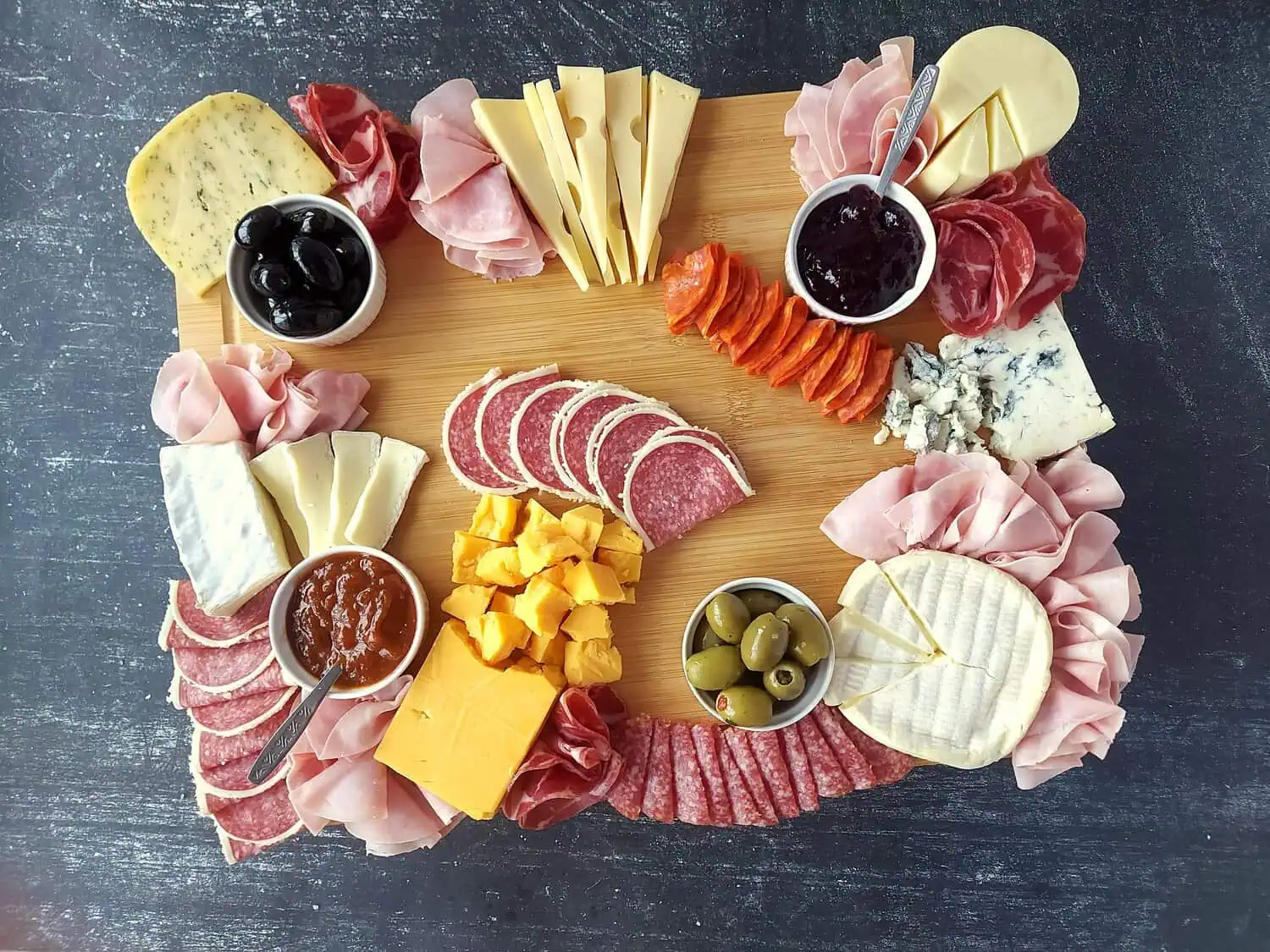
Arrange spreads, dips, jams, and pickled items in small bowls and small jars, and scatter them across the board to balance flavors and prevent crowding. Don’t forget the small spoons for easy serving. (My Simple Hot Honey Sauce Recipe pairs beautifully with the semi-soft and creamy cheeses.)
For similar colors, place them on opposite sides of the board to keep the visual interest.
Depending on the size of your board, add 2 or 3 of the sweet and savory options, and add 1 or 2 of the briny elements for cutting through the richness of the meats and cheeses.
Use 2 tbsp (1 oz, 28 g) of spreads, dips, or jams per person if served as an appetizer, or 4 tbsp (2 oz, 56 g) per person if it’s the main meal.
Add about 1/2 cup of pickled items per person if served as an appetizer, or 1 cup per person if it’s the main meal.
Step 5 – Arrange the crackers, crusty breads, and carbs
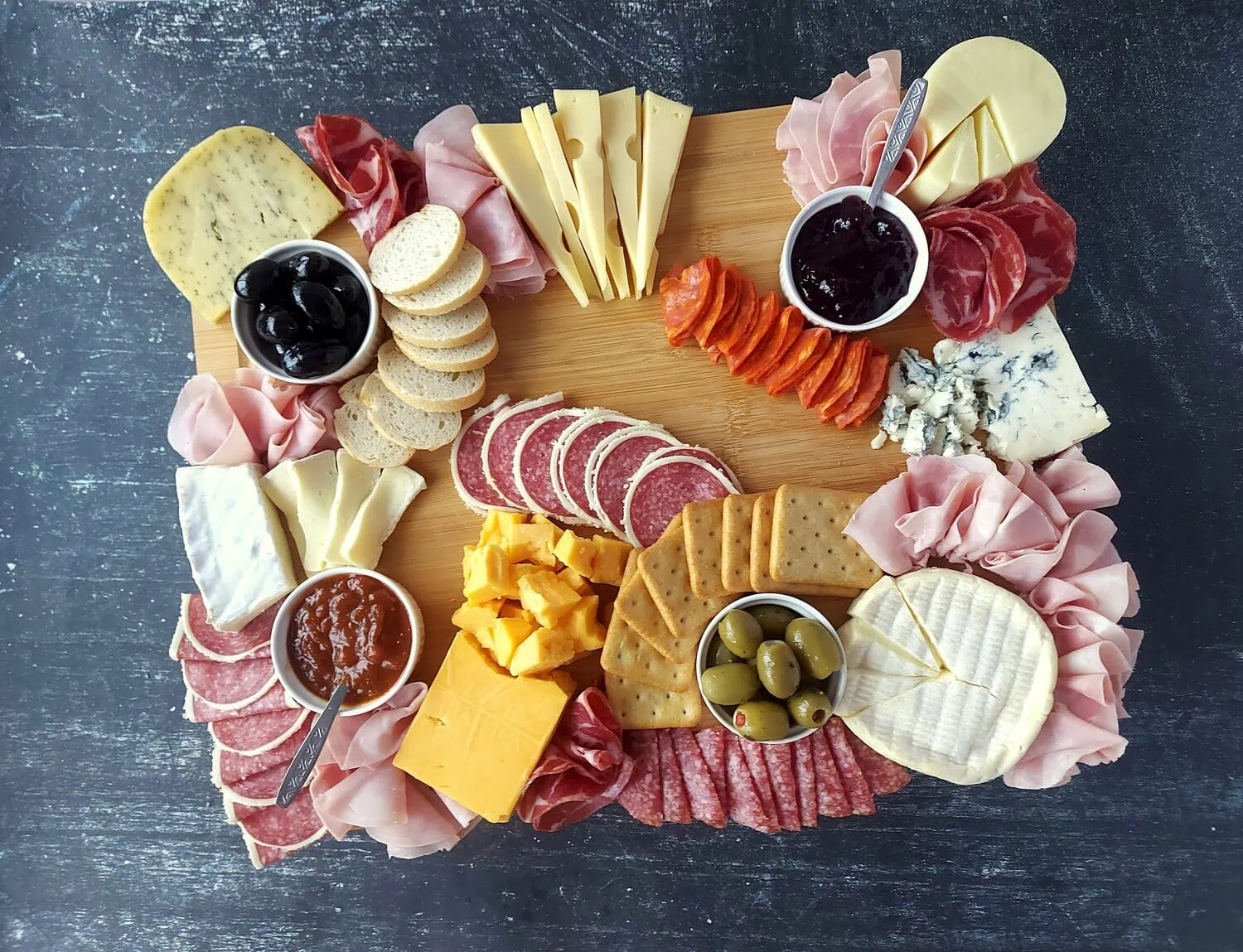
Arrange crackers and crunchy carbs in small piles or loose rows around the board, keeping them away from wet ingredients, so they stay crisp.
Place breadsticks in a jar or glass to add height and dimension to your board, breaking up the flat arrangement of the other items.
Add 4-8 pieces/bread slices (4-6 oz, 115-170 g) per person if served as an appetizer or 8-12 pieces/bread slices (6-8 oz, 170-225 g) per person if it’s the main meal.
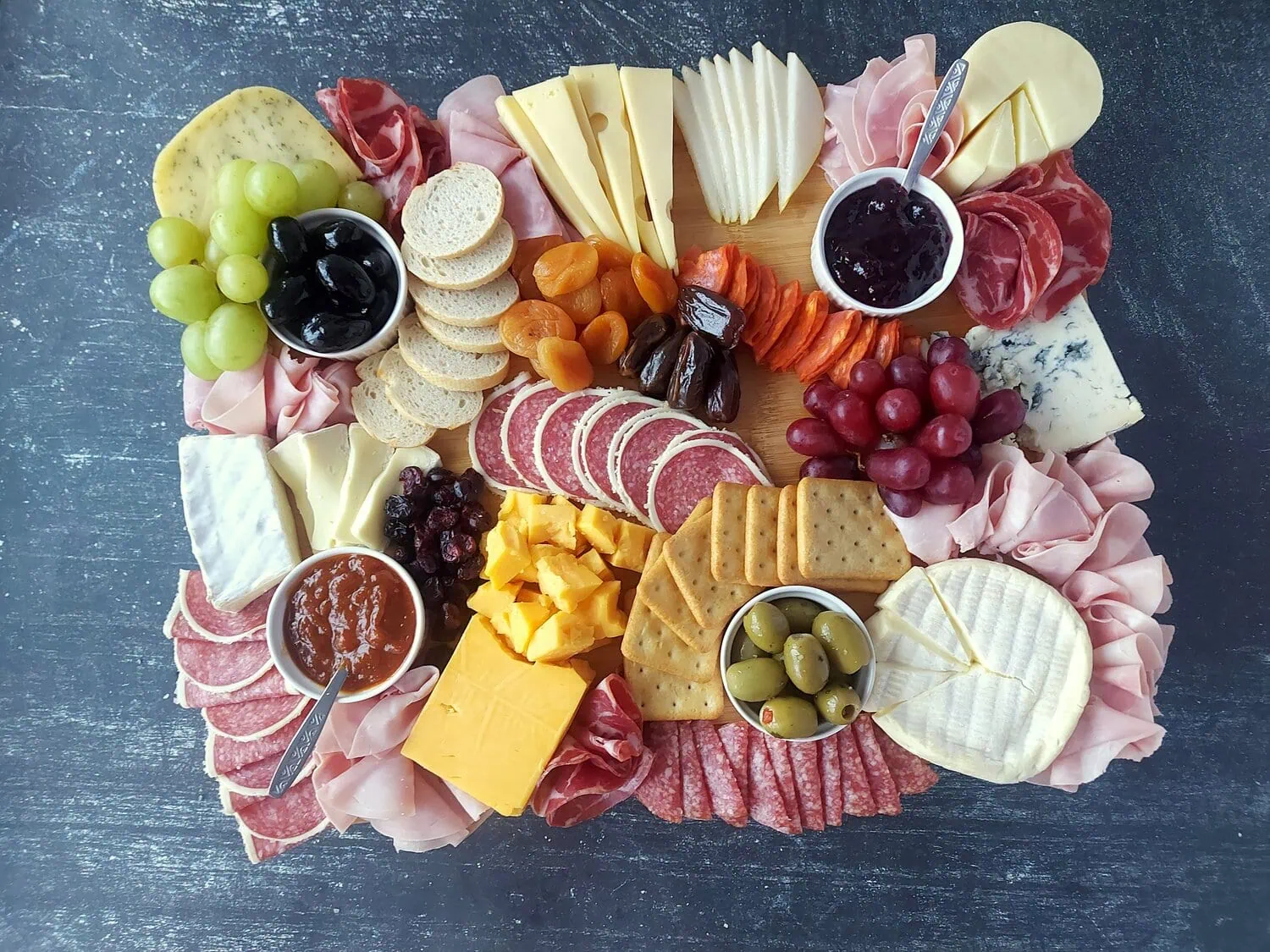
Step 6 – Fresh and dried fruits
Arrange fresh fruit first, in larger clusters, then use dried fruit to fill gaps and add pops of color.
If using grapes, use different colored ones for variety, and cut them into smaller bunches so guests can easily help themselves.
Fill the remaining gapps with the dried fruit, but leave a few open spaces to finish things off with the nuts.
Add 1/2 cup (2-3 oz, 55-85 g) of fresh fruit per person if served as an appetizer, or 1 cup (4-5 oz, 115-140 g) per person if it’s the main meal.
Add 1-2 tbsp (0.5-1 oz, 15-28 g) of dried fruit per person if served as an appetizer, or 2-4 tbsp (1-2 oz, 28-56 g) per person if it’s the main meal.
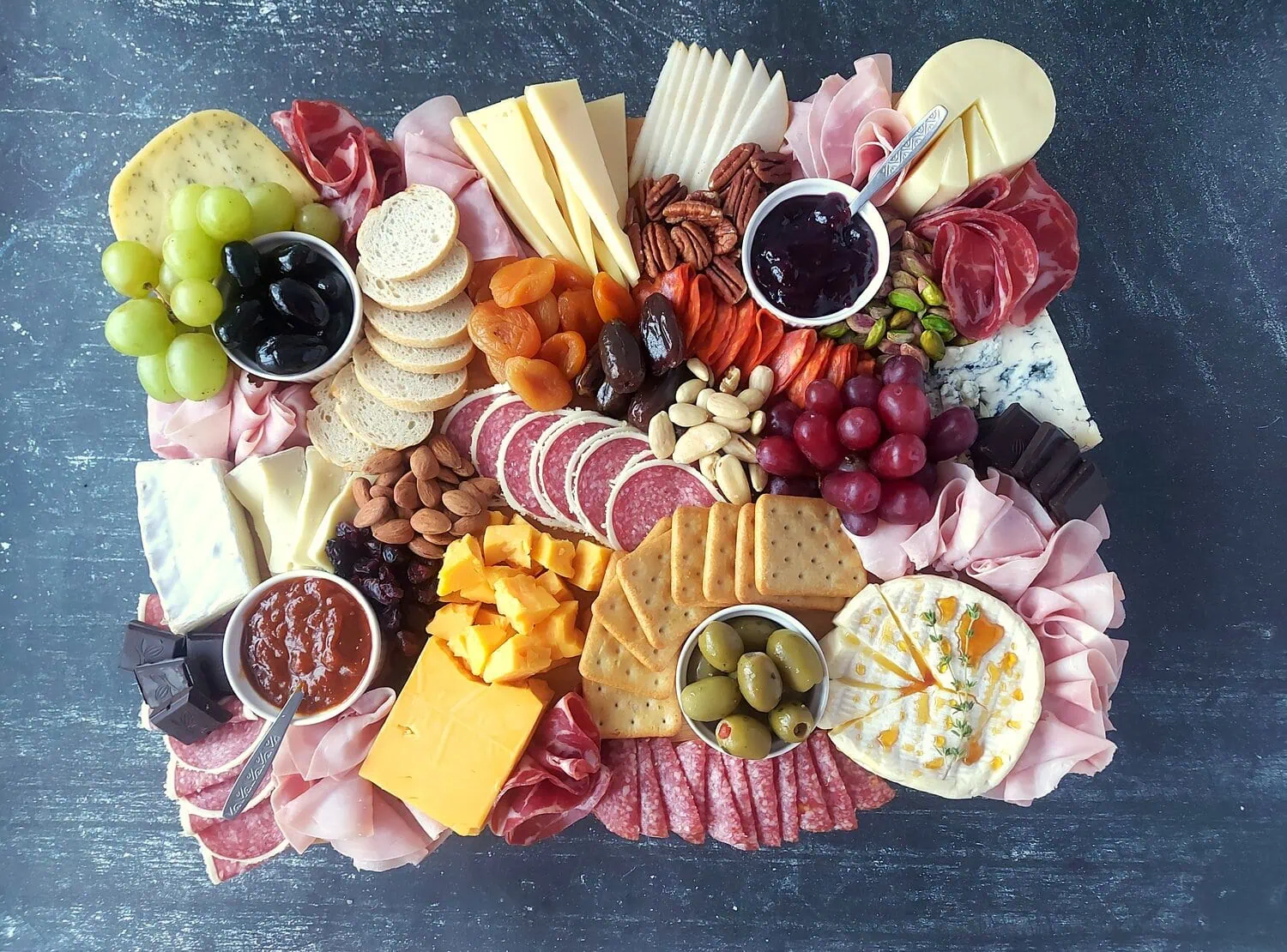
7. Nuts and sweets
Scatter nuts and sweets around the board to fill the last empty spaces and add crunch, sweetness, and texture.
Your board will immediately feel complete and abundant.
Add 2-3 tbsp per person if served as an appetizer, or 1/4 cup per person if it’s the main meal.
8. Final touches
Finish the charcuterie board by adding cheese knives, small spoons, fresh herbs, or a drizzle of honey.
Use herbs like rosemary, thyme, basil, or sage sprigs. Or leafy greens such as arugula or baby spinach as a base or scattered around the board.
Finish with a drizzle of honey (use a honey dipper if you have one) to complement both soft and hard cheeses.
Also, set out a few cocktail picks or toothpicks so guests can easily grab whatever catches their eye.
And don’t forget to provide napkins and small plates for easy serving.
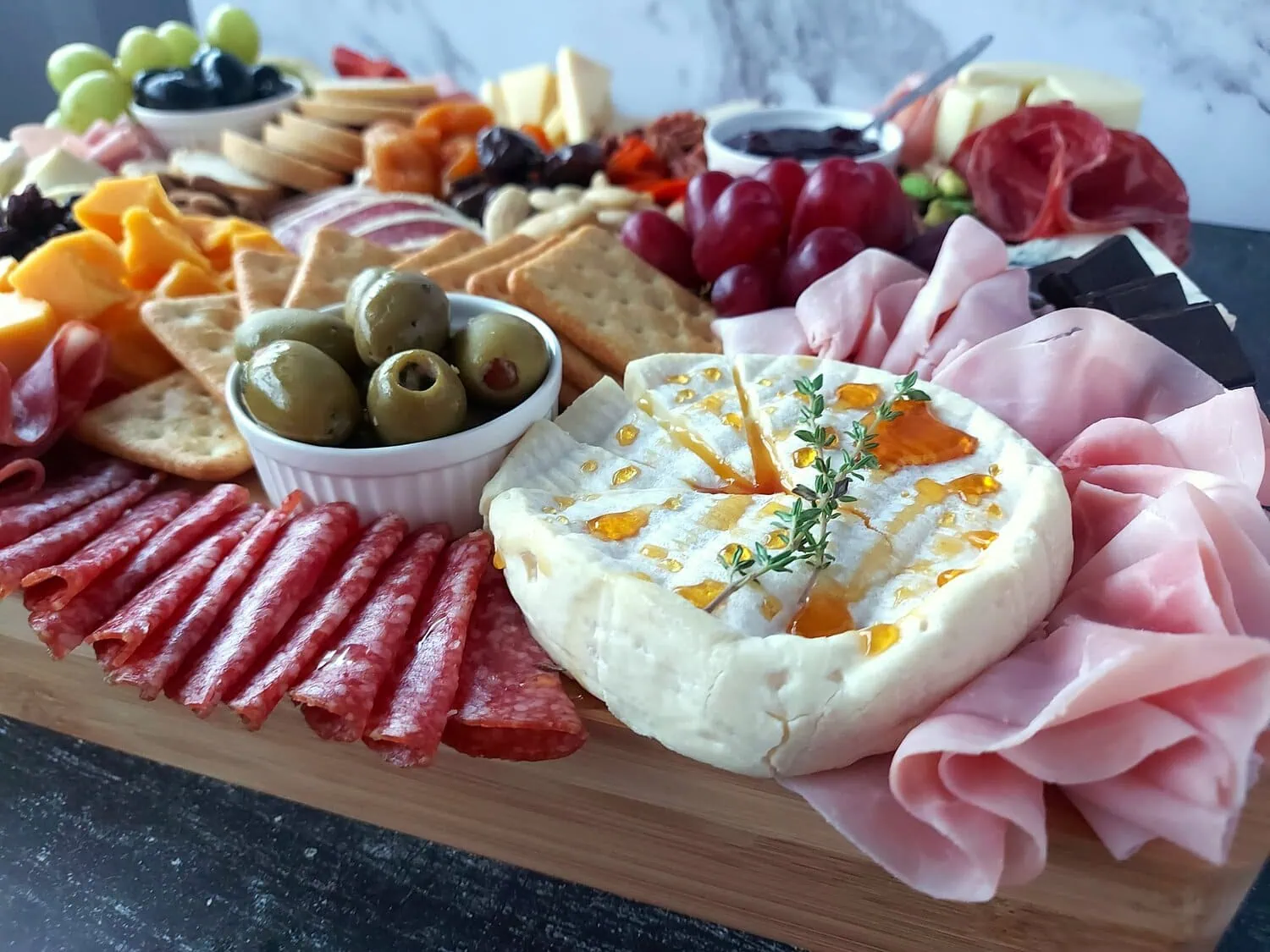
You did great! Your charcuterie board is ready now. No perfection required – just good food, good company, and something you made with care. Trust me, your guests will feel it the moment they lay eyes on your board. Now relax, pour yourself a drink, and enjoy the fruits of your effort right along with your guests!
Pro Tips Summary
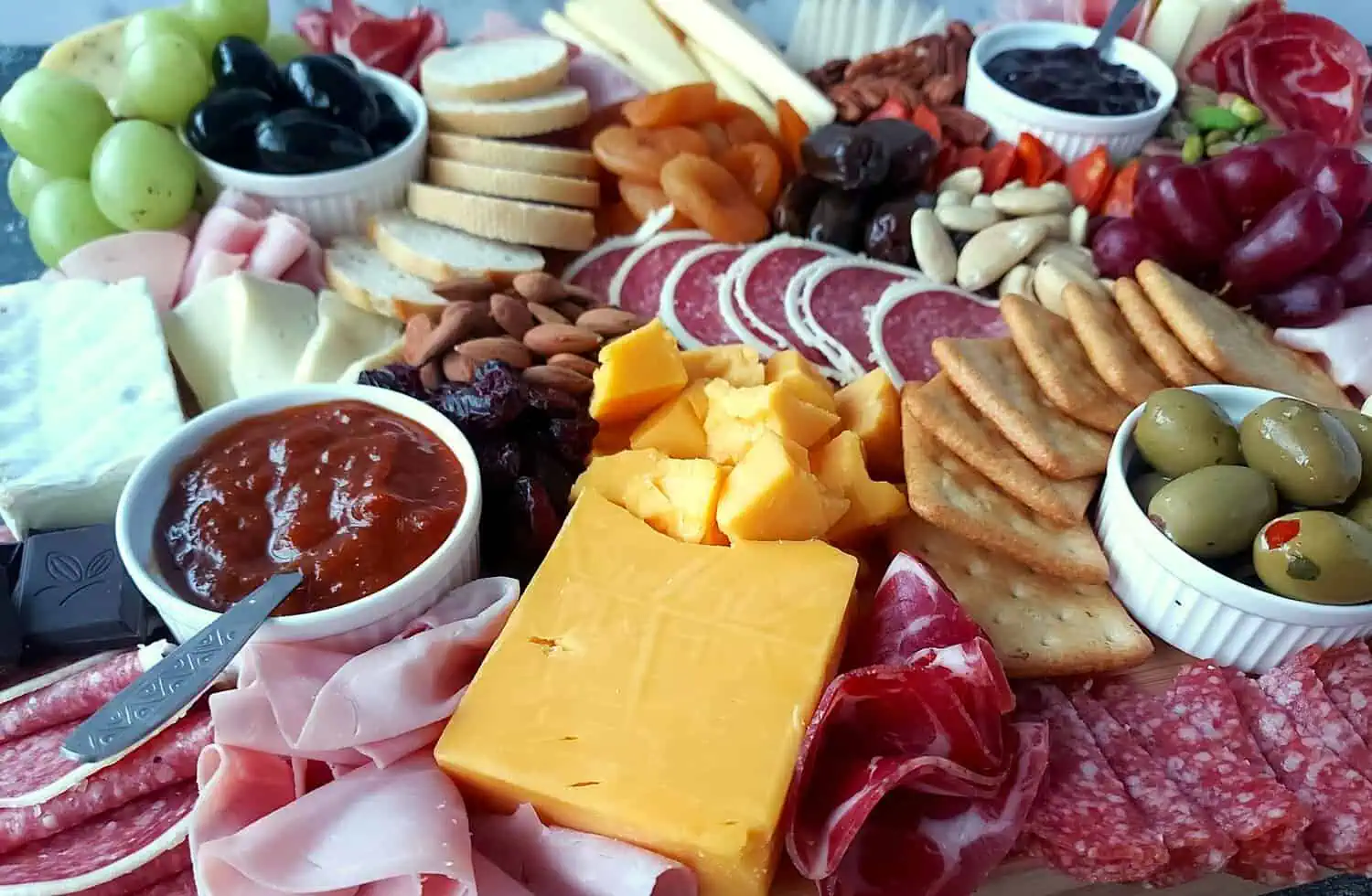
Offer variety – include a mix of flavors (sweet, salty, savory, tangy), textures (soft, firm, creamy, crunchy), shapes (wedges, cubes, slices, crumbled), and colours (white, yellow, red, orange, green, blue). Aim for at least three types of cheese and three types of meat for a well-balanced board.
Artfully arrange the meats – fold cured meats into ribbons or rosettes for visual appeal and ease of grabbing. Salami slices can be folded in half or quarters and fanned out like a deck of cards.
Use small bowls – they keep wet ingredients contained and help define sections of the board
Fill the gaps – use crackers, nuts, fresh and dried fruit to fill empty spaces and create a full, abundant look.
Garnish thoughtfully – finish with fresh herbs like rosemary, thyme, sage, or basil for a simple, elegant touch.
Replenish as you go – especially for larger groups, you don’t need to put everything on the board at once. Keep extra meats, cheeses, crackers, and fruits nearby in the kitchen, and top up the board as needed throughout the party so it always looks full and inviting.
Provide the right utensils – include cheese knives, small spoons, tongs, cocktail picks or toothpicks, plus napkins and small plates so guests can easily help themselves.
Don’t overcomplicate it – build the board with your guests in mind, choosing items they’ll actually enjoy, instead of focusing on overly fancy or expensive ingredients.
Consider appetites – if your guests have hearty appetites or the board is the main event, plan for slightly larger portions.
Serve at room temperature – let the board sit out for 30–60 minutes before serving, so the cheeses reach their best flavor and texture.
Themed Charcuterie Board Ideas:
Since charcuterie boards are so easy to put together, they’re perfect for just about any occasion. They are always a crowd-pleaser, and let you spend less time in the kitchen and more time enjoying the party with your guests. So here are a few themed charcuterie board ideas to inspire your next spread.
Brunch Charcuterie Board:
- Soft cheeses: Brie, cream cheese, goat cheese
- Breakfast meats: Prosciutto, smoked salmon, bacon (or candied bacon)
- Breads & carbs: croissants, mini bagels, waffles, pancakes
- Spreads: butter, honey, fruit preserves, lemon curd
- Fruits: berries, grapes, citrus slices
- Extras: hard-boiled eggs, mini quiches, yogurt with granola
- Optional add-ons: jam jars, honey dipper, fresh herbs
Dessert Charcuterie Board:
- Chocolates: dark, milk, white, truffles
- Cookies & Baked Goods: brownies, macarons, shortbread, biscotti
- Fruits: strawberries, raspberries, cherries, dried figs
- Dips & Spreads: Nutella, chocolate sauce, caramel, marshmallow fluff
- Crunchy Elements: pretzels, waffle cones, graham crackers
- Finishing Touches: powdered sugar dusting, mint leaves
Halloween Charcuterie Board:
- Cheeses: white cheddar, orange cheddar, pepper jack
- Meats: salami, prosciutto (folded into “roses” or “ribbons”)
- Crackers: black crackers, pumpkin-shaped crackers
- Fruits & Veggies: grapes, apple slices, baby carrots
- Sweets: candy corn, chocolate eyeballs, gummies
- Spreads: black olive tapenade, pumpkin hummus
- Garnish: mini pumpkins, spooky picks
Christmas Charcuterie Board:
- Cheeses: aged cheddar, brie, gouda, blue cheese
- Meats: prosciutto, salami, jamón
- Fruits: pomegranate seeds, grapes, pears, dried cranberries
- Nuts: spiced pecans, walnuts, almonds
- Crackers & Bread: rosemary crackers, crostini
- Spreads: fig jam, honey, cranberry sauce
- Garnish: rosemary sprigs, star anise, cinnamon sticks
Game Day Charcuterie Board:
- Cheeses: sharp cheddar, pepper jack, smoked gouda
- Meats: summer sausage, salami, chorizo
- Crunchy Carbs: tortilla chips, pretzel bites, crackers
- Dips: queso, guacamole, salsa, ranch
- Veggies: celery, bell peppers, cherry tomatoes
- Extras: pickles, olives, jalapeños
- Optional: sliders or wings on the side
Valentine’s Day Charcuterie Board:
- Cheeses: Brie, Camembert, goat cheese, blue cheese
- Meats: prosciutto, coppa, salami
- Fruits: strawberries, raspberries, cherries
- Sweets: chocolate truffles, chocolate-covered nuts
- Crackers: heart-shaped or pink-toned crackers
- Spreads: honey, berry jam
- Garnish: edible flowers, rose petals
Easter Charcuterie Board:
- Cheeses: Havarti, goat cheese, mild cheddar
- Meats: ham slices, prosciutto
- Fruits: grapes, strawberries, pineapple, kiwi
- Veggies: radishes, snap peas, carrots
- Breads: rolls, crostini
- Extras: deviled eggs, mini hot cross buns
- Garnish: herbs, pastel-colored accents
4th of July Charcuterie Board:
- Cheeses: white cheddar, mozzarella, pepper jack
- Meats: salami, summer sausage
- Fruits: strawberries, blueberries, watermelon
- Crackers & Bread: classic crackers, sliced baguette
- Dips: hummus, ranch, berry jam
- Crunch: popcorn, pretzels
- Garnish: mini flags, red-white-blue accents
Charcuterie Board FAQ:
Should a charcuterie board be served at room temperature?
Yes – let the board sit out for 30–60 minutes before serving. This brings cheeses to their optimal flavor and makes meats more aromatic.
How many people does a charcuterie board serve?
A charcuterie board can serve anywhere from 2 to 20+ people, depending on its size and whether it’s an appetizer or the main event. As a general guideline, plan for 2-3 ounces of cheese and 2-3 ounces of meat per person, if it’s served as an appetizer. If the board is the main meal, increase that to 4-5 ounces of cheese and 4-5 ounces of meat per person, along with extra bread, fruit, and accompaniments. Bigger boards don’t just feed more people – they also create that abundant, wow-factor presentation guests love.
What is the 3-3-3 rule for a charcuterie board?
The 3-3-3 rule is a simple formula that helps you build a balanced board without overthinking it. It suggests including 3 cheeses, 3 meats, and 3 accompaniments (like crackers, fruit, nuts, or spreads). This rule works especially well for small gatherings and beginner boards. It gives you variety in flavor and texture while keeping things easy and approachable. You can always scale up by adding more items once you’re comfortable.
How many cheeses should I include on a charcuterie board?
A balanced board typically has 3, 5, or 7 cheeses, mixing soft, semi-soft, hard, and bold/funky varieties to appeal to different tastes.
How should I arrange the meats?
Fold, layer, or fan meats and place them in different areas of the board for balance and visual appeal. Thin slices like prosciutto or ham can be folded into ribbons or rosettes, while salami can be fanned or stacked.
How do I arrange spreads, dips, jams, and pickled items?
Place them in small bowls or jars and scatter them around the board. Keep similar colors apart for visual interest, and provide small spoons for easy serving.
What fruits and nuts work best on a charcuterie board?
Use a mix of fresh fruits like grapes, apples, pears, figs, and berries, along with dried fruits like apricots, cherries, figs, or cranberries. Add nuts like Marcona almonds, walnuts, or pecans to fill gaps and add texture.
What finishing touches make a board look professional?
Garnish with fresh herbs and leafy greens. Add cheese knives, small spoons, cocktail picks, toothpicks, napkins, and small plates. These elevate the presentation and make it functional for the guests.
At the end of the day, a great charcuterie board is all about variety, balance, creativity, and having fun. Now that you know what to put on a charcuterie board, let this guide help you get started, then trust your instincts and make it your own. Don’t stress about making it perfect – work with what you have, and enjoy the process. If it feels good to you, your guests will love it!
If this Charcuterie Board makes it to your table, drop a comment below and tell me how it turned out. And whether your guests hovered around it all night – because that’s usually the best sign of success!
Other recipes you might like
- How to Make an Easy Valentine’s Day Charcuterie Board
- No Bake Tiramisu Cheesecake People Go Crazy For!
- Greek Slow Roasted Leg of Lamb (Fall Off the Bone!)
- Cranberry Apple Stuffed Pork Loin (Festive & Refined)
- Deviled Eggs Recipe with Bacon (Unexpected Twist!)
- Quick and Healthy Breakfast Quiche Recipe with Spinach
- Healthy Ham and Mushroom Frittata Recipe (So good!)
- Salted Caramel Tiramisu | Creamy, Easy & No-Bake
What to Put on a Charcuterie Board (Tips and Tricks)
Ingredients
CHEESE
- 5 oz (150 g) Brie cheese
- 5 oz (150 g) Camembert
- 5 oz (150 g) Artisanal cheese
- 4 oz (115 g) Herb Gouda
- 5 oz (150 g) Emmentaler
- 7 oz (200 g) Sharp Cheddar
- 4 oz (115 g) Gorgonzola
MEATS
- 4 oz (115 g) genoa salami
- 4 oz (115 g) salami parmesan
- 4 oz (115 g) chorizo
- 5 oz (150 g) prosciutto cotto
- 3 oz (85 g) capicola
SPREADS, DIPS, JAMS, CONDIMENTS, AND PICKLED ITEMS
- 6 oz (170 g) apricot jam
- 6 oz (170 g) mixed berry jam
- 2.5 cups pimento stuffed green olives
- 2.5 cups black olives
CRACKERS, CRUSTY BREADS, AND CRUNCHY CARBS
- 1 baguette
- 15 oz (425 g) crackers
FRESH AND DRIED FRUITS
- 13 oz (370 g) green grapes
- 13 oz (370 g) red grapes
- 1 pear
- 4 oz (115 g) dates
- 4 oz (115 g) dried apricots
- 4 oz (115 g) dried cranberries
NUTS AND SWEETS
- 4 oz (115 g) pecan nuts
- 4 oz (115 g) pistachios
- 4 oz (115 g) almonds
- 4 oz (115 g) Brazilian nuts
- 5 oz (140 g) dark chocolate (at least 70% cocoa)
FINAL TOUCHES
- 2-3 sprigs thyme (rosemary, sage, or basil)
- drizzle of honey (on the cheese)
- cheese knives
- small spoons
- cocktail picks or toothpicks
- napkins
- small plates
Use these amounts as a general guide and adjust them based on your needs. The quantities listed here are what I prepared for serving 12 adults as an appetizer - not everything went on the board at once, but the extras were used to refill the board throughout the party. I used a 12×18-inch (30×45 cm) board.
Instructions
- BOARDSelect the board depending on the number of your guests and the occasion. 5 guests: a board around 12 x 18 inches (30 x 46 cm) or a large round board, 14–15 inches (36–38 cm)10 guests: a board around 16 x 24 inches (41 x 61 cm) or two medium boards15 guests: a board around 18 x 30 inches (46 x 76 cm) or multiple boards spread out20 guests: use a large serving table, kitchen island, or several boards arranged together
- CHEESE Use 2-3 oz (55-85 g) of cheese per person if served as an appetizer, or 4-5 oz (115-140 g) per person if it's the main meal.Choose 3, 5, or 7 types of cheese and arrange them around the board to create a starting framework. Include at least one cheese from each category (use 1 soft /1 spreadable, 1 semi-soft, 1 hard, 1 bold/funky cheese). Cut into different shapes - wedges, cubes, slices, crumbled, whole.Choose a variety of colors: white, yellow, red, herby green, and blue.
- MEATUse 2-3 oz (55-85 g) of cheese per person if served as an appetizer, or 4-5 oz (115-140 g) per person if it's the main meal.Choose 3-5 types of meat and create sort of a border around the board, to keep the smaller items from spilling outLeave small salami slices as they are and arrange them in an overlapping straight, wavy, or diagonal line, or fan them out like a deck of cards.For larger slices, fold in half or quarters and place them either in a line or grouped in different areas of the board.For skinny meats such as prosciutto, ham, or bresaola, fold them into loose ribbons or flowers. To make ribbons, gently pick up one slice of prosciutto and loosely fold it back and forth into soft waves, almost like a ribbon. Let it fall naturally onto the board. To make florettes, take a larger salami slice and pinch it in the center, bringing the outer edges together to form a flower shape. Pair two florettes together and place them next to a block of cheese for support, so they don’t unfold.
- SPREADS, DIPS, SWEET TOUCHES, AND BRINY OR PICKLED ITEMSUse 2 tbsp (1 oz, 28 g) of spreads, dips, or jams per person if served as an appetizer, or 4 tbsp (2 oz, 56 g) per person if it's the main meal.Use about 1/2 cup of pickled items per person if served as an appetizer, or 2/3 cup per person if it's the main meal.Arrange spreads, dips, jams, and pickled items in ramekins, small bowls, and small jars, and scatter them across the board. Add small spoons for easy serving.Place similar colors on opposite sides of the board.Depending on the size of your board, add 2 or 3 of the sweet and savory options (at least 1 sweet), and 1 or 2 of the briny elements.
- CRACKERS, CRUSTY BREADS, AND CRUNCHY CARBSUse 6-8 pieces/bread slices (1-1.5 oz, 28-42 g) per person if served as an appetizer or 10-12 pieces/bread slices (3.5-4 oz, 100-113 g) per person if it's the main meal.Arrange crackers, bread slices, crostini, and crunchy carbs in small piles or loose rows around the board, keeping them away from wet ingredients, so they stay crisp.Place breadsticks in a jar or glass to add height and dimension to your board.
- FRESH AND DRIED FRUITSUse 1/2 cup (2-3 oz, 55-85 g) of fresh fruit per person if served as an appetizer, or 1 cup (4-5 oz, 115-140 g) per person if it's the main meal.Use 1-2 tbsp (0.5-1 oz, 15-28 g) of dried fruit per person if served as an appetizer, or 2-4 tbsp (1-2 oz, 28-56 g) per person if it's the main meal.Arrange fresh fruits first, in larger clusters, then use dried fruit to fill gaps. If using grapes, use different-colored ones, and cut them into smaller bunches.Fill the remaining gaps with the dried fruit, but leave a few open spaces to finish things off with the nuts.
- NUTS AND SWEETSUse 2-3 tbsp per person if served as an appetizer, or 1/4 cup per person if it's the main meal.Scatter the nuts and sweets around the board to fill the last empty spaces.
- FINAL TOUCHESGarnish with fresh herbs like rosemary, thyme, basil, or sage sprigs, or use leafy greens such as arugula or baby spinach as a base or scattered around the board. Finish with a drizzle of honey (use a honey dipper if you have one) to complement both soft and hard cheeses.Add cheese knives, small spoons, cocktail picks, or toothpicks.Provide napkins and small plates for easy serving.

Leave a Reply