This festive and elegant-looking Cranberry Apple Stuffed Pork Loin tastes incredible and is the perfect holiday centerpiece if you want to switch things up a bit. Trust me, you won’t be disappointed!
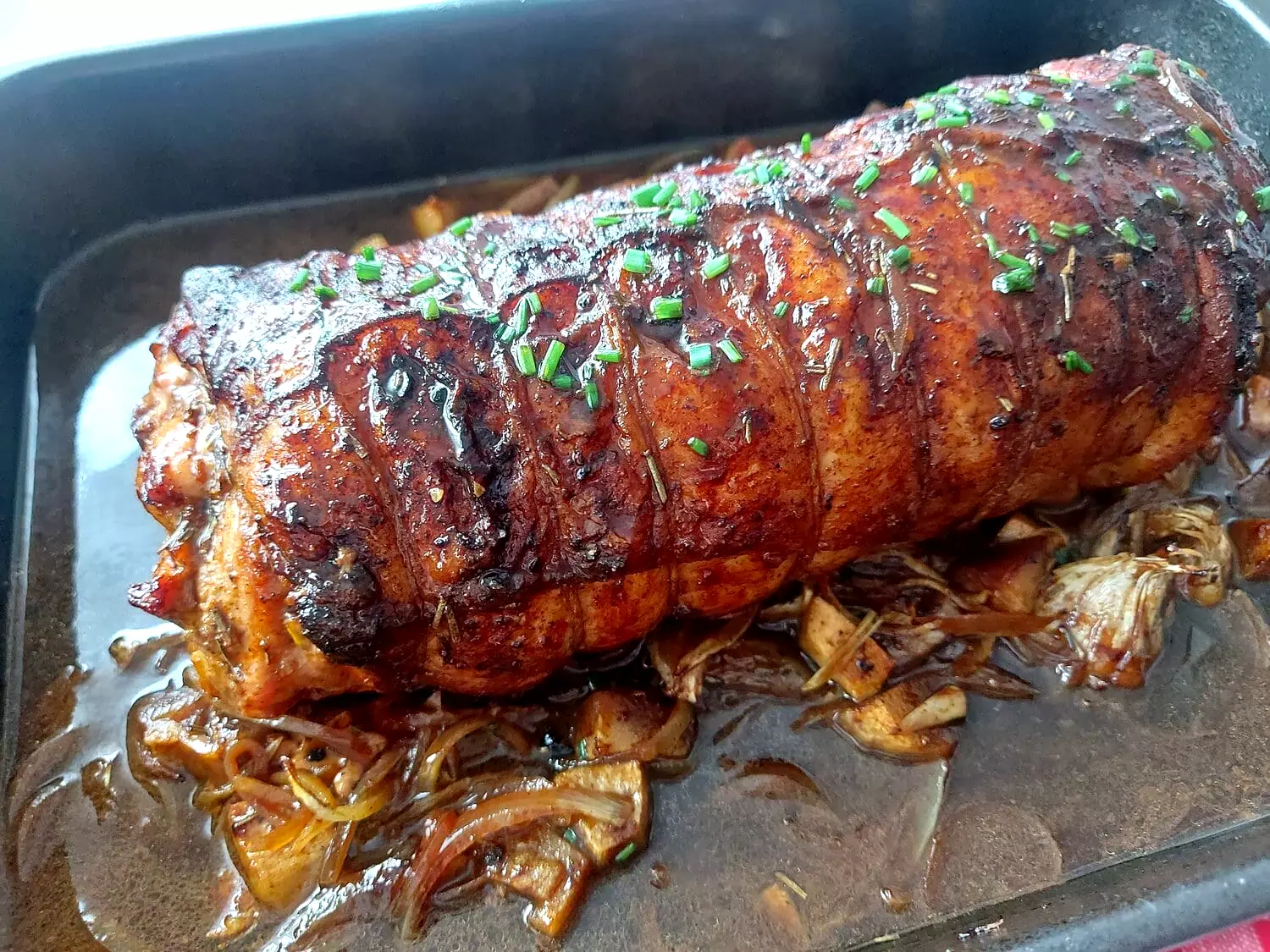
This Cranberry Apple Stuffed Pork Loin is an impressive dish that makes any meal feel instantly special. The juicy pork, sweet apples, and tart cranberry sauce with a touch of fresh herbs and aromatics create such amazing flavors that your dinner is sure to be a total success!
If you’ve never made a stuffed pork loin before, and this is your first time, I understand that it can look quite intimidating at first, but it’s actually easier than it looks. It does take a bit of patience, but it is definitely worth the time and effort, as it is both impressive and delicious.
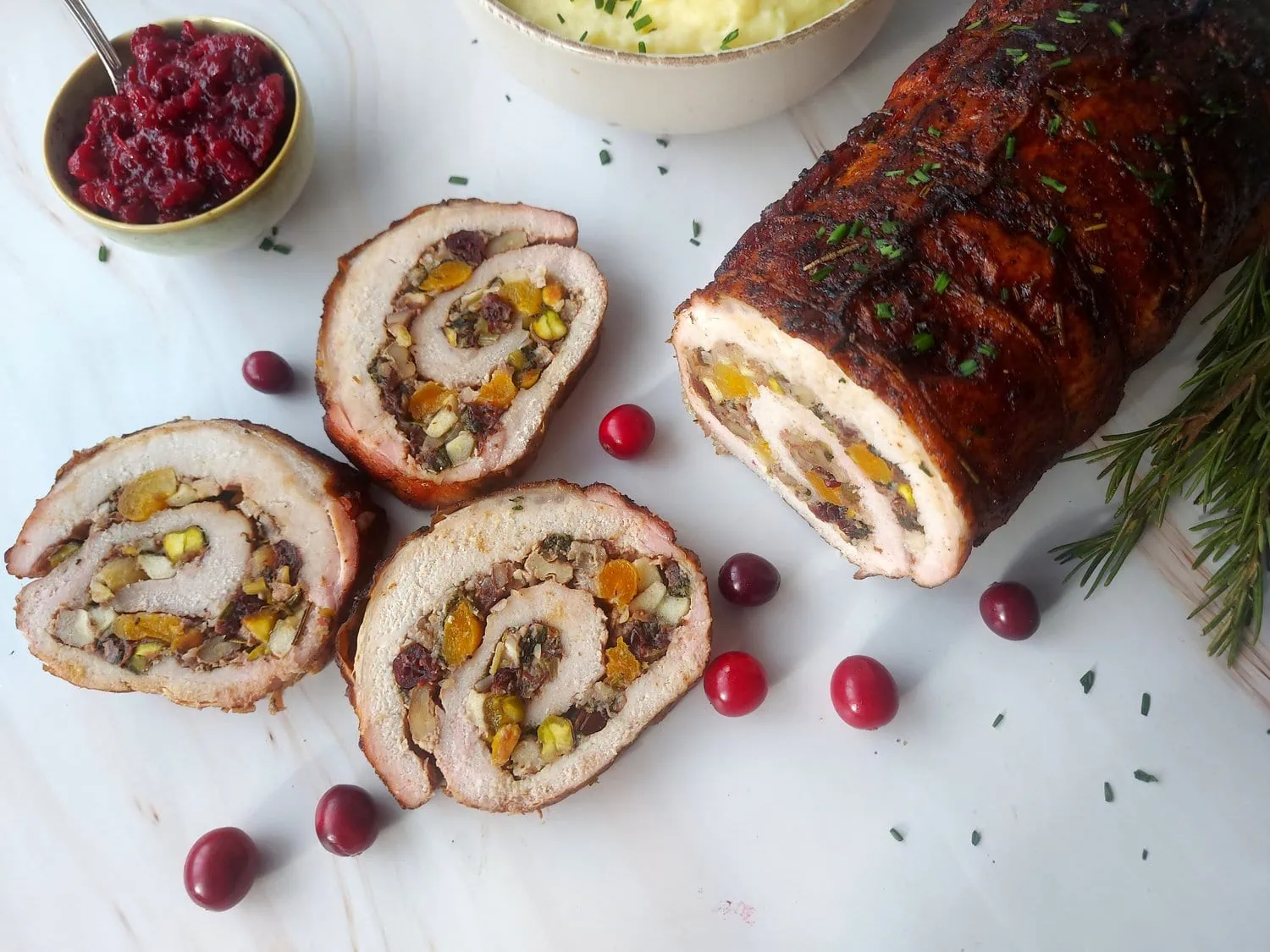
Why You’ll Love This Cranberry Apple Stuffed Pork Loin
Festive and Elegant: This pork loin feels special enough for holidays, dinner parties, or any occasion where you want to impress. It looks gorgeous on the table without needing fancy plating skills.
Perfect for Entertaining: It’s a centerpiece-worthy main dish that draws people to the table and fills the kitchen with amazing aromas. Everyone will want to know how you made it.
Feeds a Crowd: This pork loin is big enough to serve family and friends, making it perfect for holiday dinners, dinner parties, or any time you want to feed a hungry group without extra stress.
Incredible Flavor: Juicy pork pairs perfectly with sweet apples, tart cranberry sauce, and fragrant herbs. Every bite is a balanced mix of savory, sweet, and slightly tangy flavors that everyone will love.
Impressive, Not Intimidating: While it looks like a show-stopping dish, the steps are straightforward and manageable. With a little prep, the oven does most of the work for you.
Versatile and Memorable: Whether you’re serving it for a holiday meal, a cozy weekend dinner, or a special occasion, this recipe is the kind that will earn a permanent spot in your go-to dishes for memorable dinners.
Ingredients for This Cranberry Apple Stuffed Pork Loin
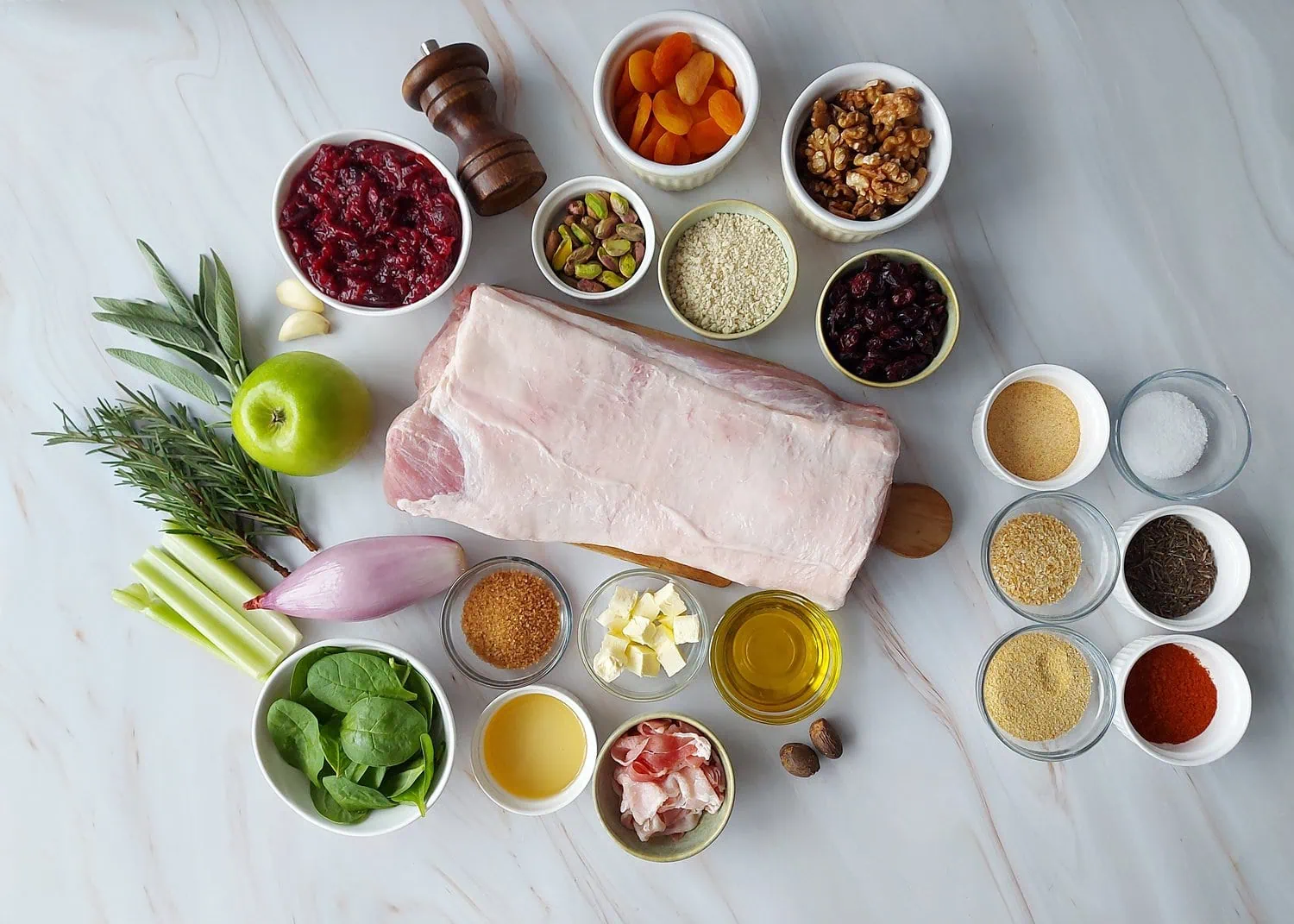
FOR THE PORK:
– 1 x (3 to 4 pounds) pork loin (center cut, not the tenderloin!)
FOR THE FILLING:
– smoked bacon
– garlic
– shallots
– celery
– Granny Smith apple
– dried cranberries
– dried apricots
– pistachios
– walnuts
– fresh spinach
– Panko breadcrumbs
– apple cider
– chicken stock
– cranberry sauce
– yellow or Dijon mustard
– brown sugar
– fresh rosemary
– fresh sage
– nutmeg
– salt and pepper
FOR THE ROASTING PAN:
– Granny Smith apple
– onion
– head of garlic
– apple cider
– chicken stock
– butter
FOR THE DRY RUB:
– garlic powder
– onion powder
– smoked paprika
– mustard powder
– dried rosemary
– salt and pepper
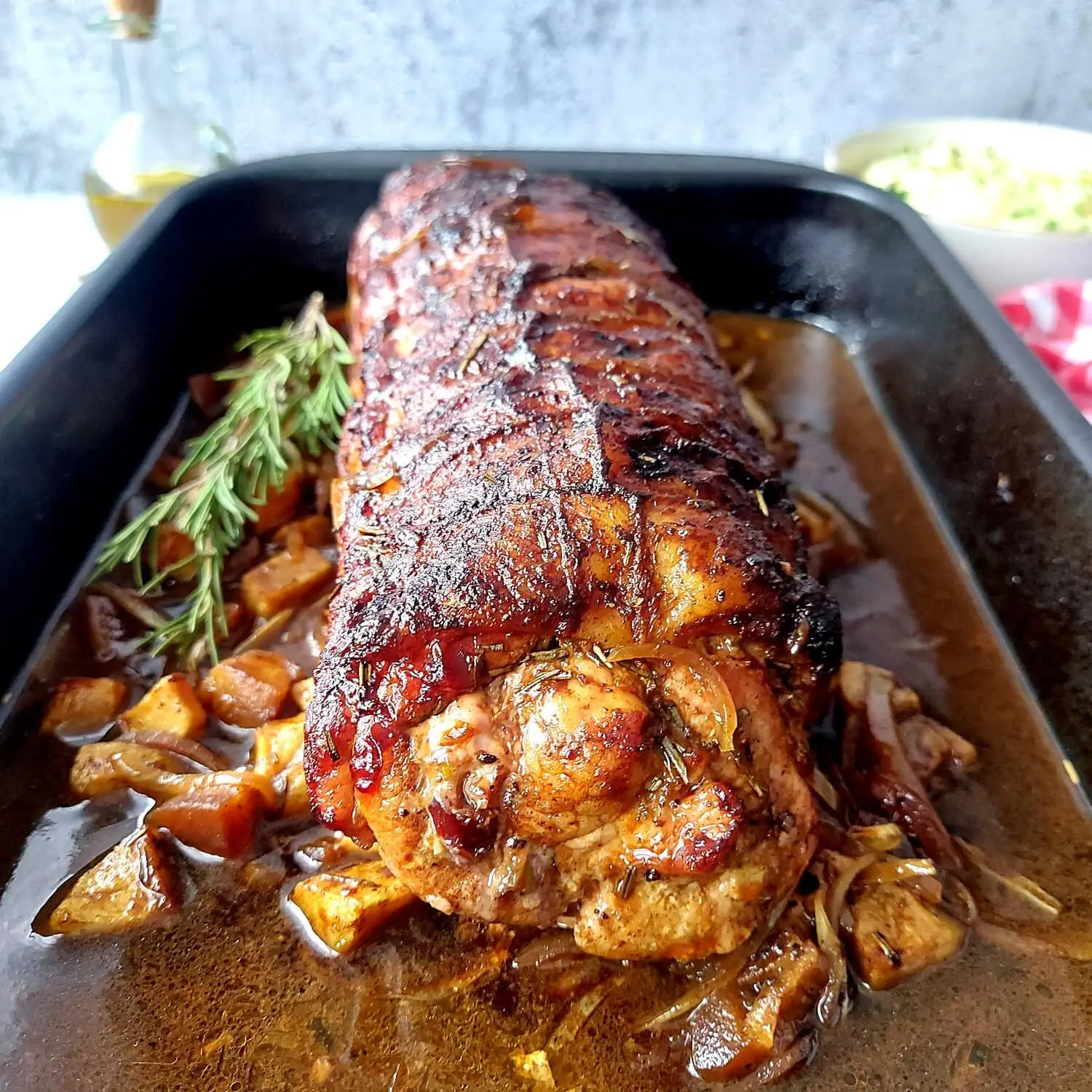
Equipment
– large roasting pan or baking dish (I used a 14×10″ roasting pan (36×25 cm))
– paring knife (for the apples, dried apricots)
– meat mallet (or rolling pin)
– instant-read meat thermometer
– blender
– small bowl
– medium bowl
– fine mesh sieve (optional)
– tongs
– measuring cups
– measuring spoons
– basting spoon / small ladle
– oven mitts
Cranberry Apple Stuffed Pork Loin at a Glance
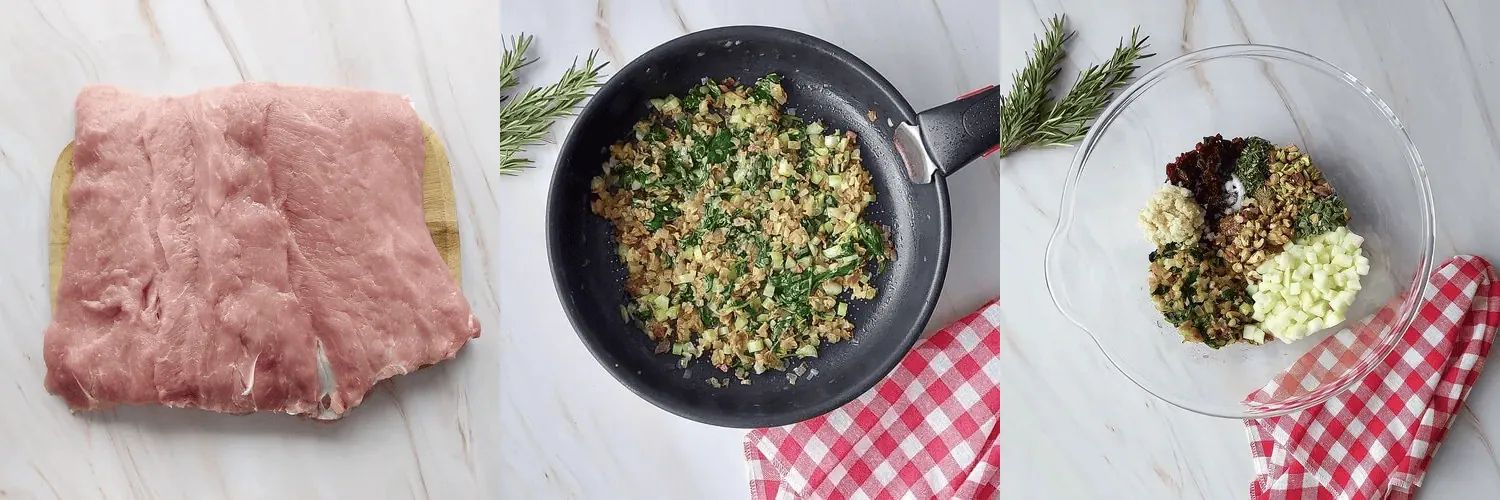
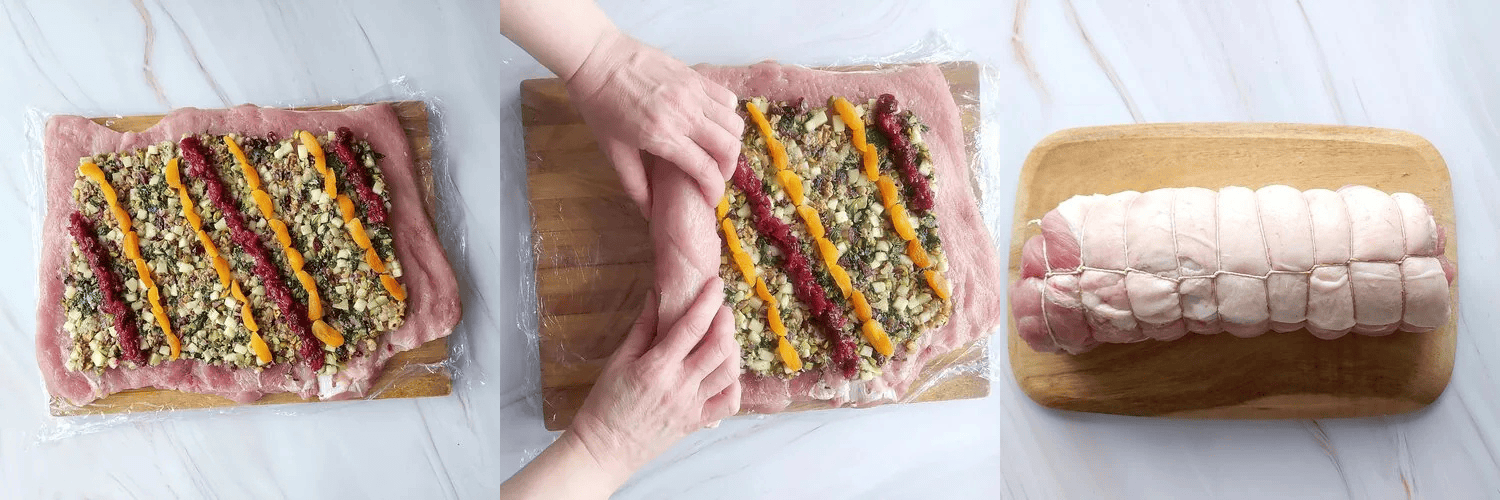
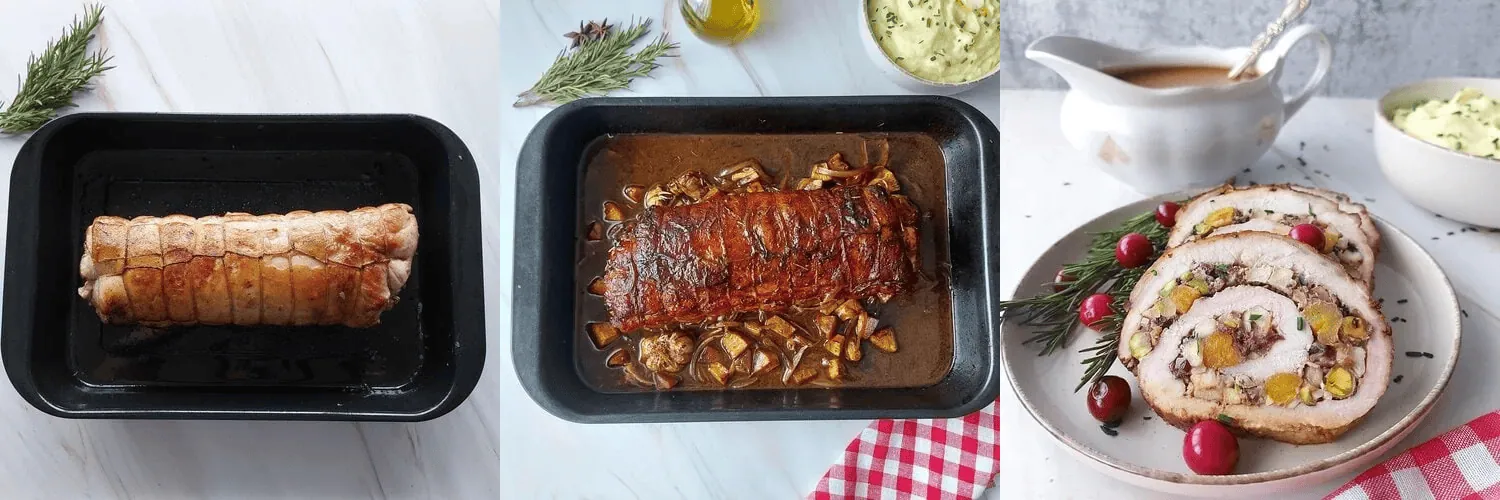
Step-by-step Guide to This Cranberry Apple Stuffed Pork Loin
(for the exact measurements and details, please see the recipe card below)
Step 1 – Prepare the filling and the dry rub
In a small bowl, mix all of the dry rub ingredients, then set aside.
In another small bowl, mix the breadcrumbs with the apple cider until fully moistened, then set aside.
Heat 2 tablespoons of oil in a pan and cook the bacon until lightly fragrant but not crisp. Add the shallots and celery and sauté until softened and translucent. Stir in 1 tablespoon of butter, then add the garlic and the brandy. Cook for about 1 minute until fragrant, and the brandy has evaporated. Finally, add the spinach and sauté for 15-20 seconds, just until wilted.
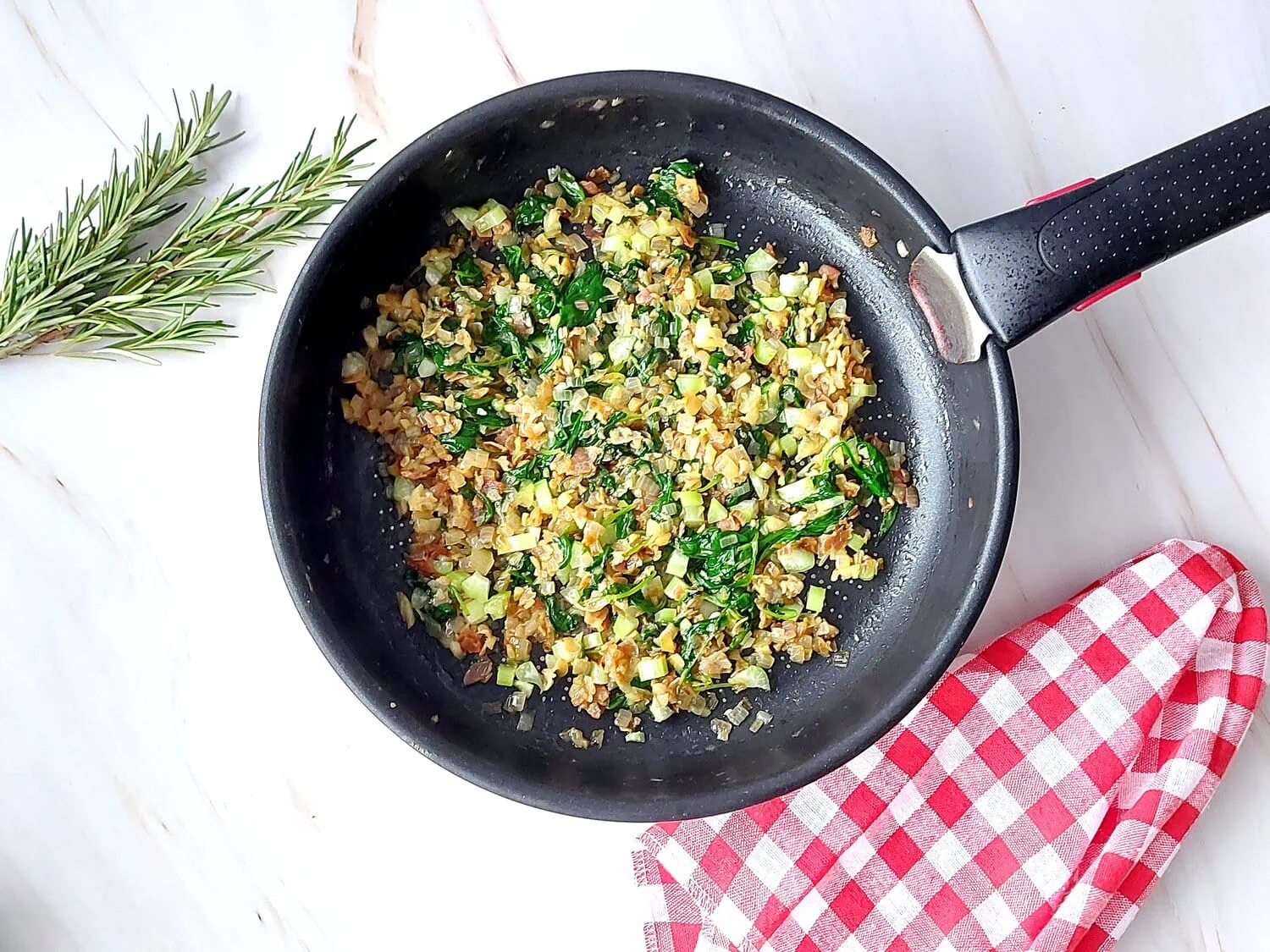
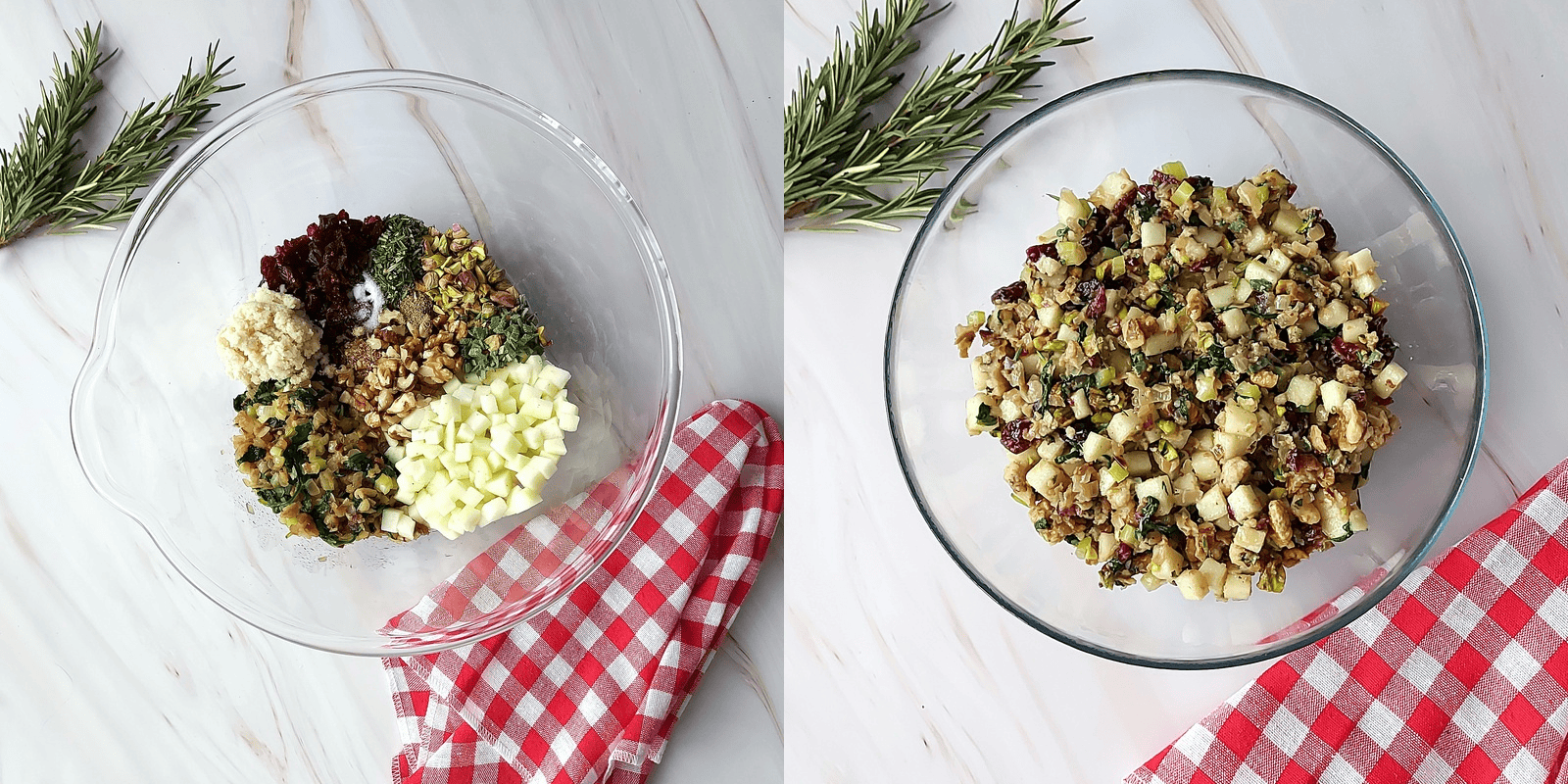
Transfer the mixture to a large bowl and add the remaining stuffing ingredients: apples, dried cranberries (do not add the dried apricots yet), pistachios, walnuts, bacon bits, mustard, sugar, nutmeg, fresh rosemary, fresh sage, breadcrumbs, and apple cider. Season with salt and pepper to taste, then let the filling cool completely.
Note: If you prefer a finer-textured filling, you can pulse the apple mixture in a food processor using 1-second pulses until you reach the desired texture. I personally prefer the chunkier texture, which I find more visually appealing.
Step 2 – Roll cut the pork loin
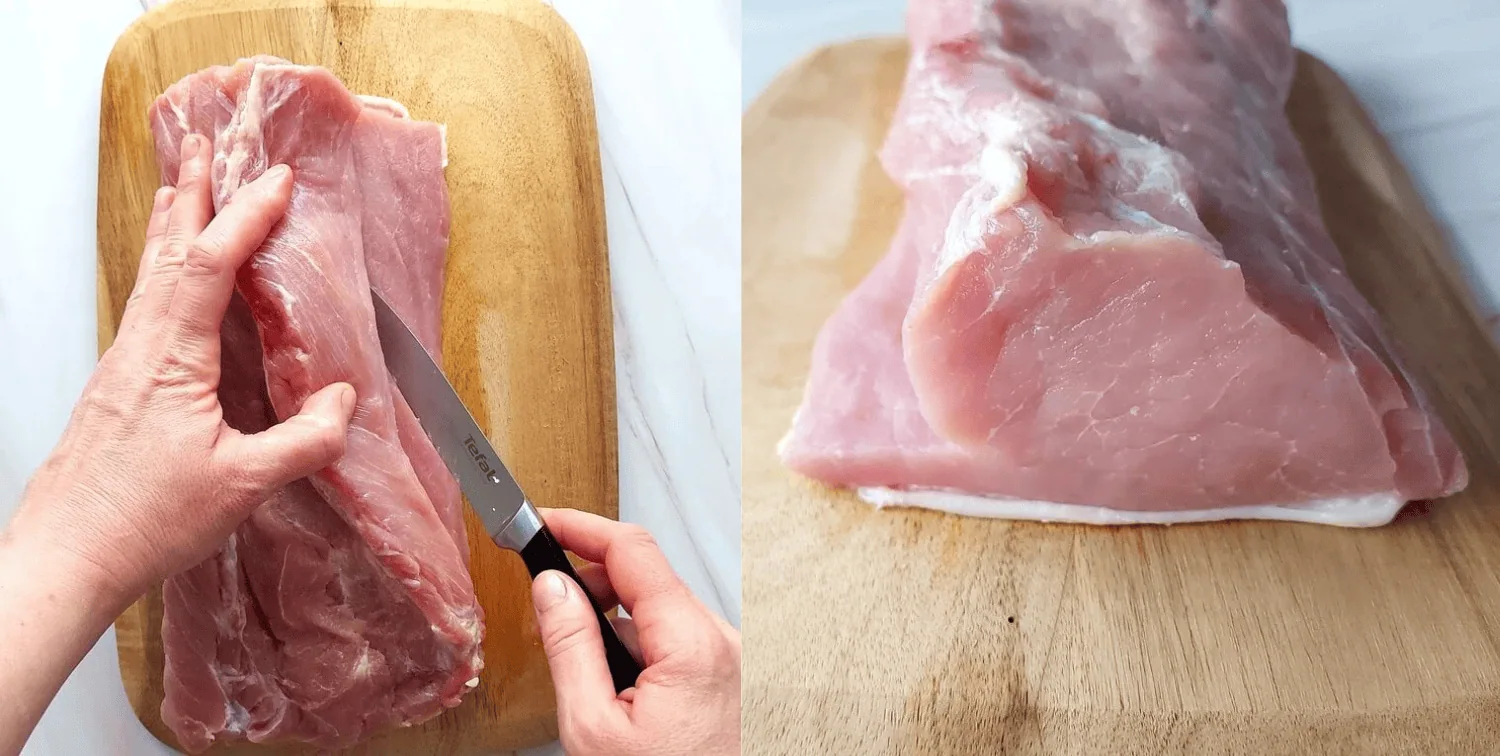
Place the pork loin fat cap down on a cutting board. Using a long sharp knife, start your first cut lengthwise along one side of the pork, holding the knife at about a 45-degree angle and slicing downward. Cut slowly and stop when you’re about ½ to ⅓ inch from the bottom, making sure you don’t cut all the way through.
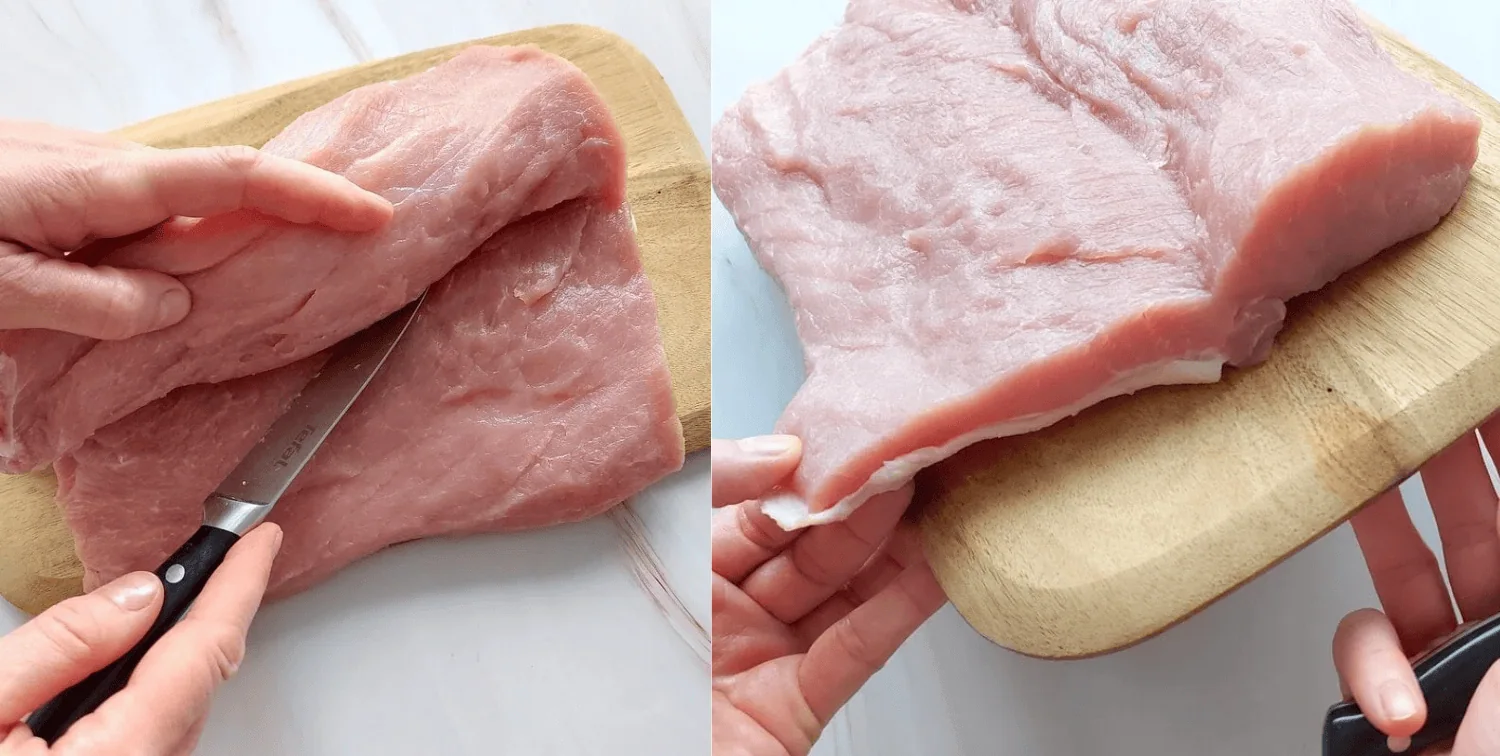
From there, turn your knife so it’s almost parallel to the cutting board and continue making long, steady cuts, gently “rolling out” the pork loin as you go until it opens into one long sheet. Try not to cut all the way through, but if it happens, don’t worry — it’s totally fine. Just keep going carefully, and the pork will still roll up nicely.
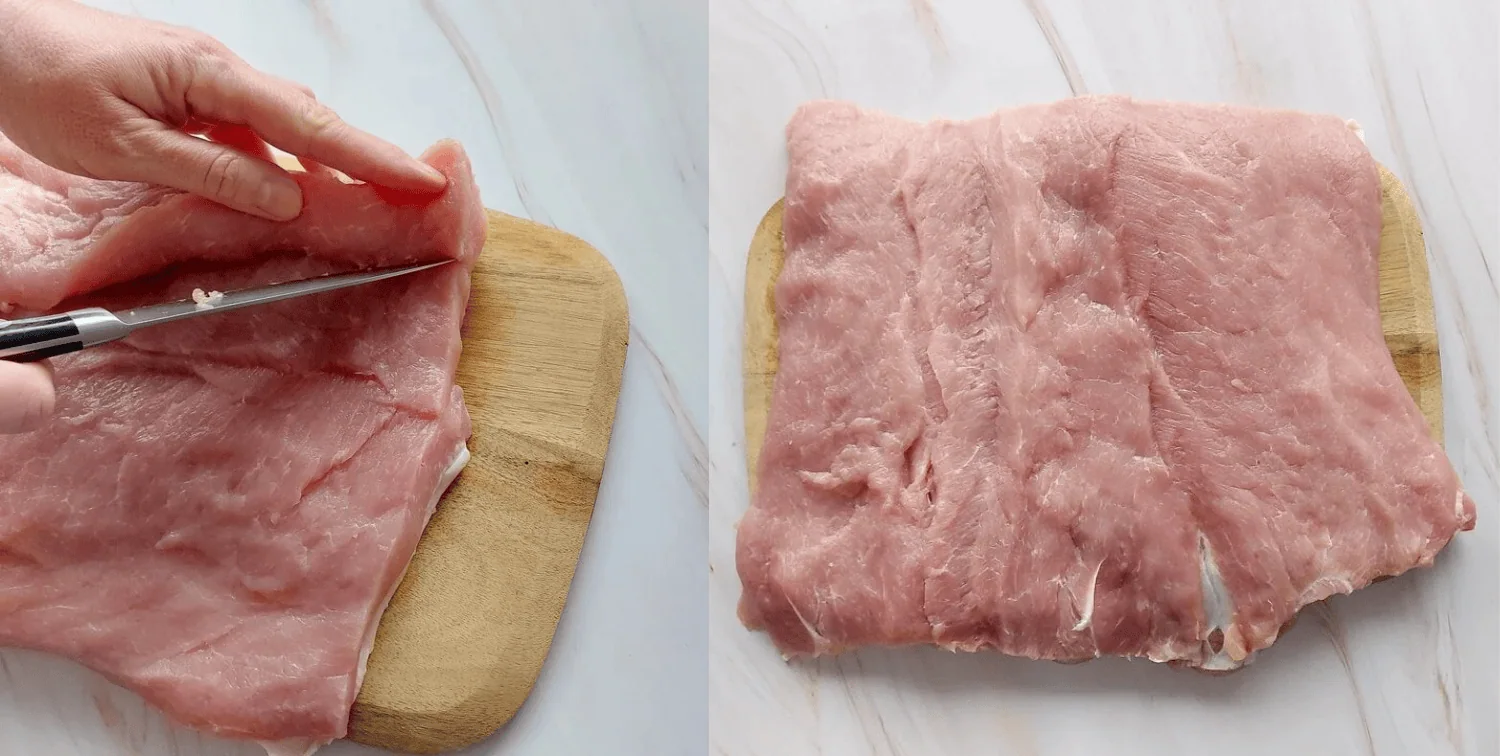
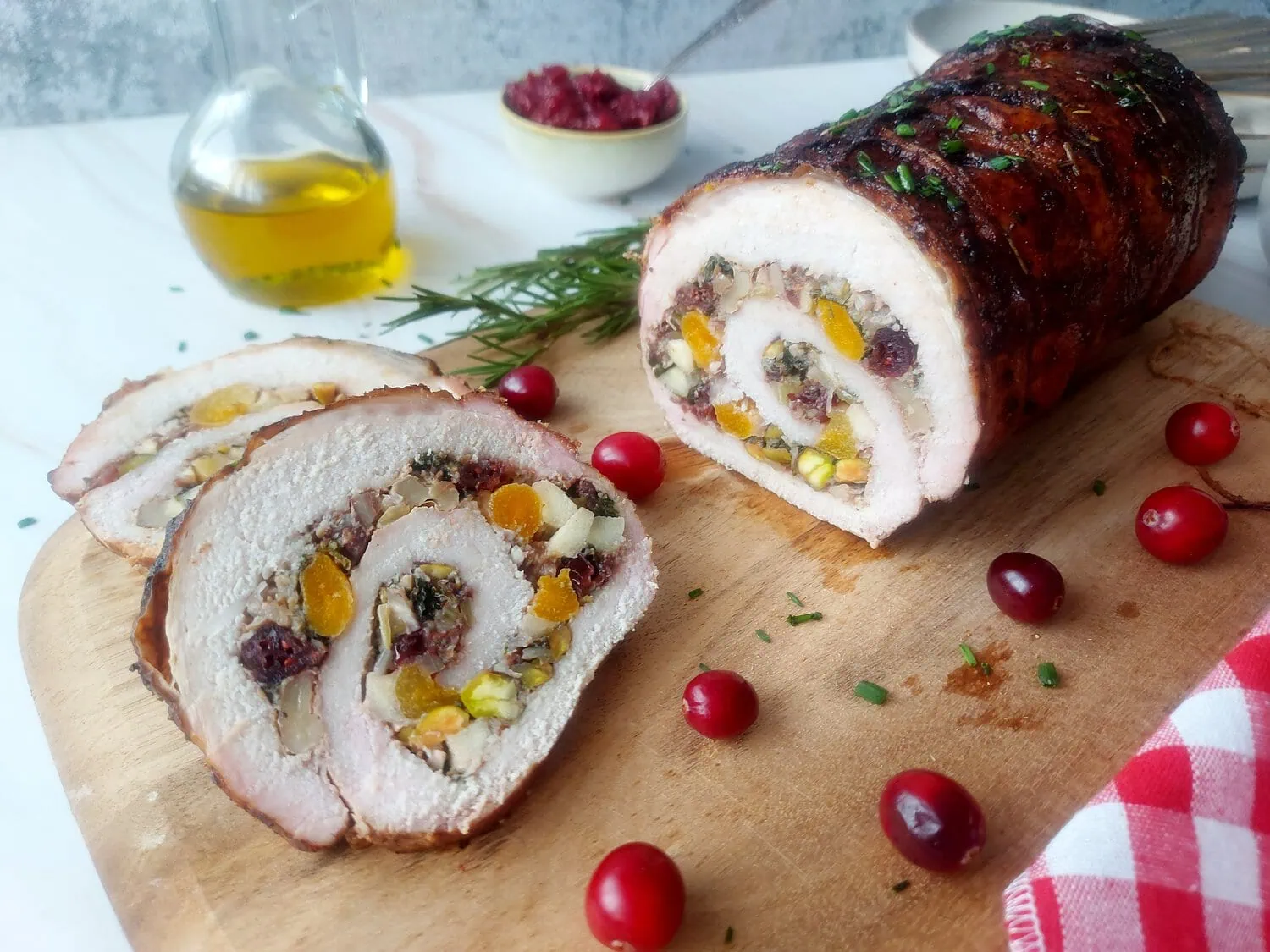
Your goal is to create one long, flat piece of pork that has an even thickness – about ½ to ⅓ inch thick. A thinner cut will give you a longer sheet and a larger, more dramatic spiral once rolled, while a thicker cut will result in a shorter sheet and a tighter roll. Taking your time here really pays off, because this step is what gives the pork loin that beautiful, swirled look when sliced.
Pro Tip: If you’re nervous, pause after every few inches of cutting, gently open the pork to check thickness, and adjust as you go – slow and steady works best here.
Step 3 – Pound the pork loin
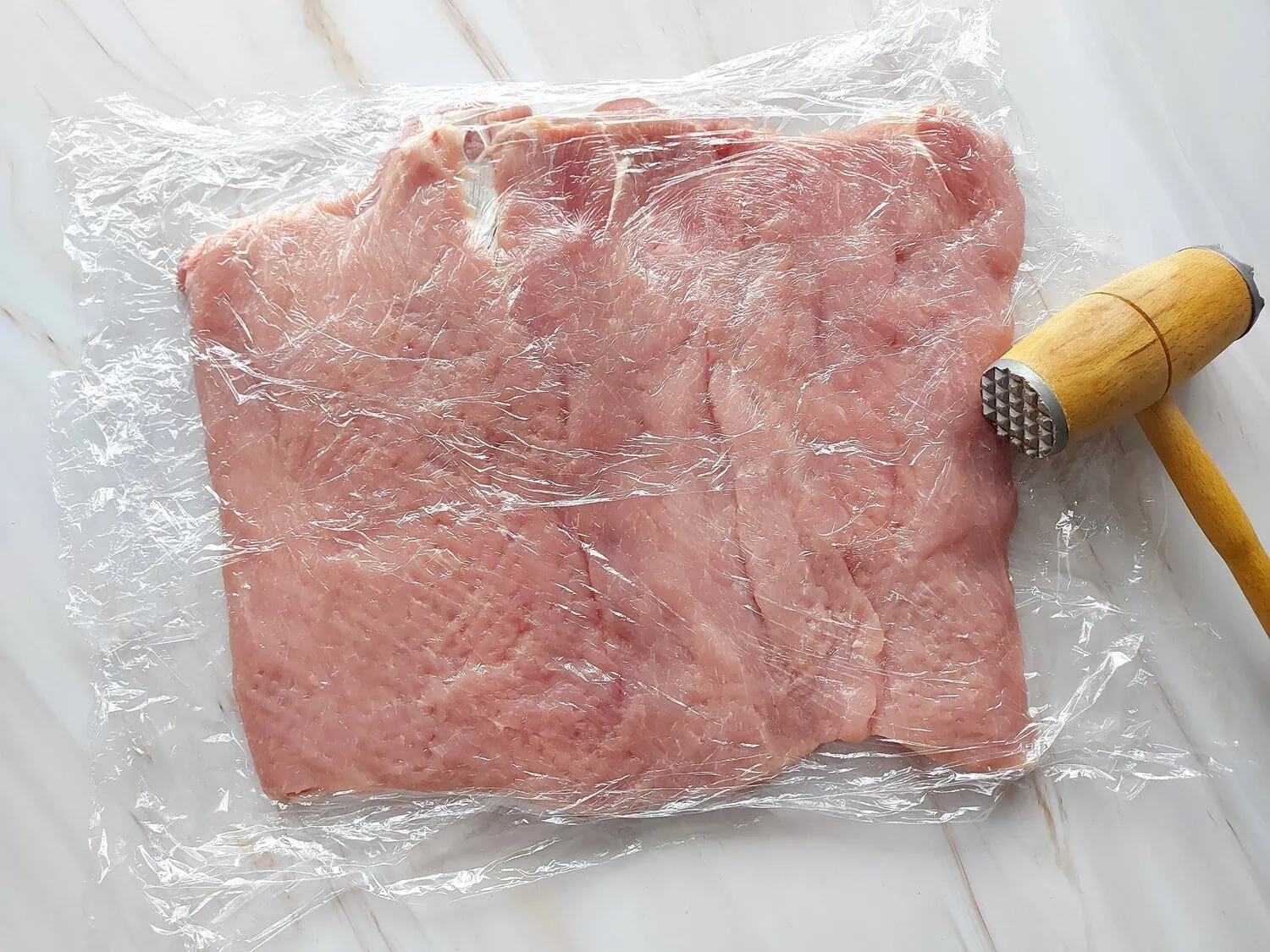
At this point, the pork will likely be uneven in thickness, so we need to flatten it out. Place the pork between two sheets of plastic wrap, then use a meat mallet to gently pound it until it’s a somewhat even thickness all over. This step also helps tenderize the meat. Remove the plastic wrap and season with salt and pepper.
Step 4 – Spread the filling and roll the pork loin
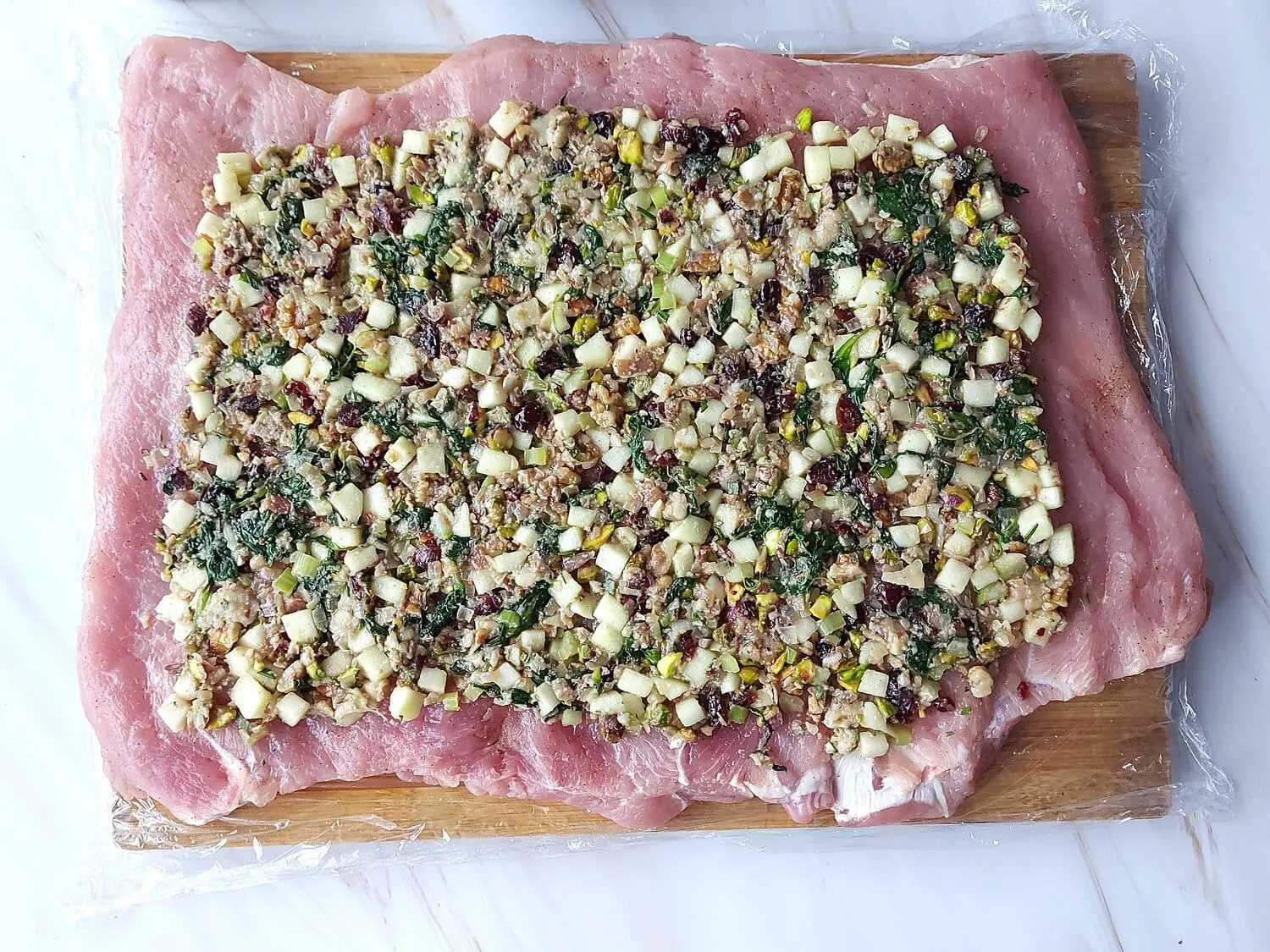
Transfer filling to the butterflied pork loin, spreading the stuffing mix into an even layer across the meat. Gently push mixture towards the edges, leaving a 1-inch border all around, to prevent it from spilling out. On the fat cap side, where you’ll finish the rolling, leave a wider 2-inch border.
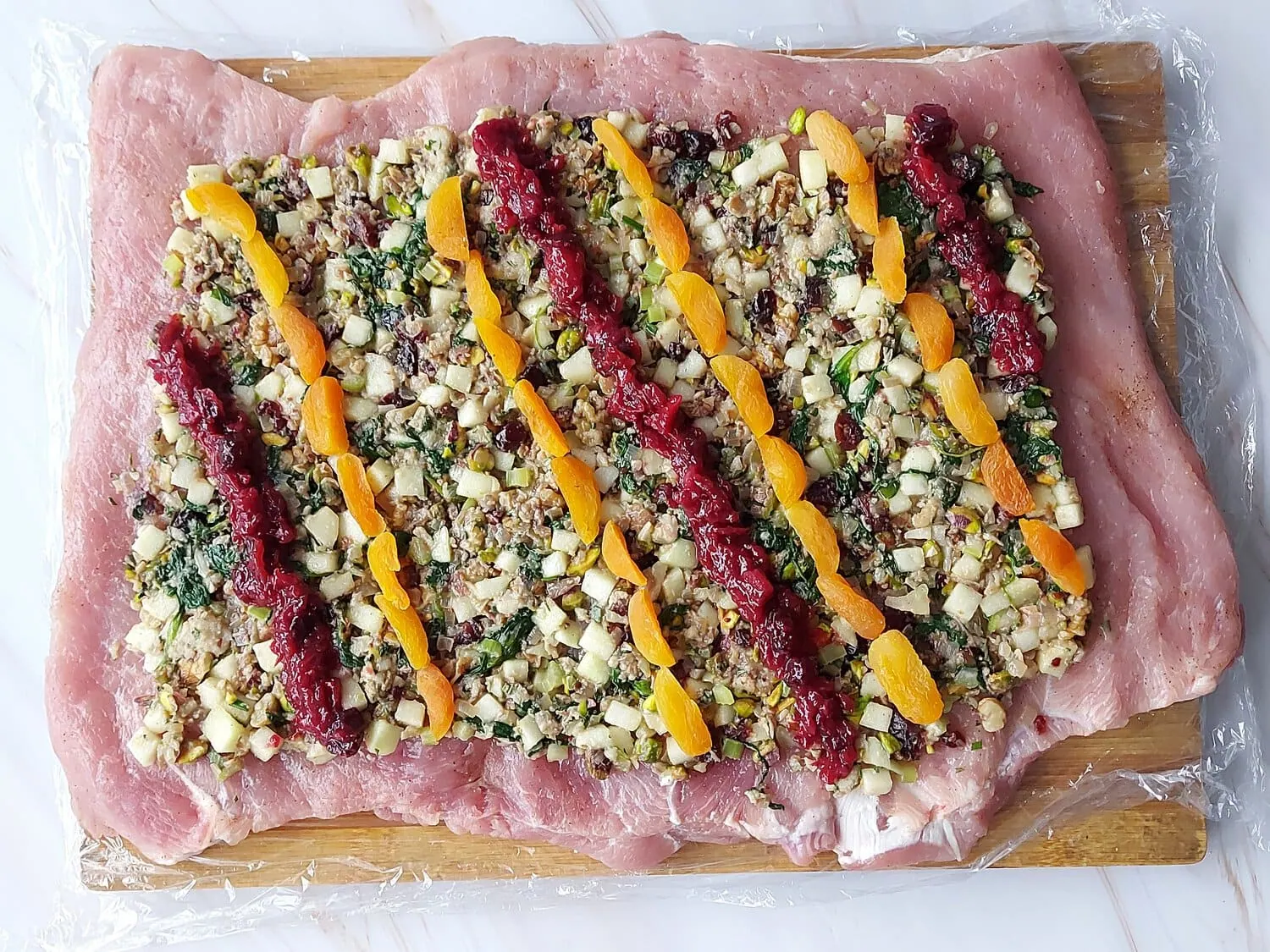
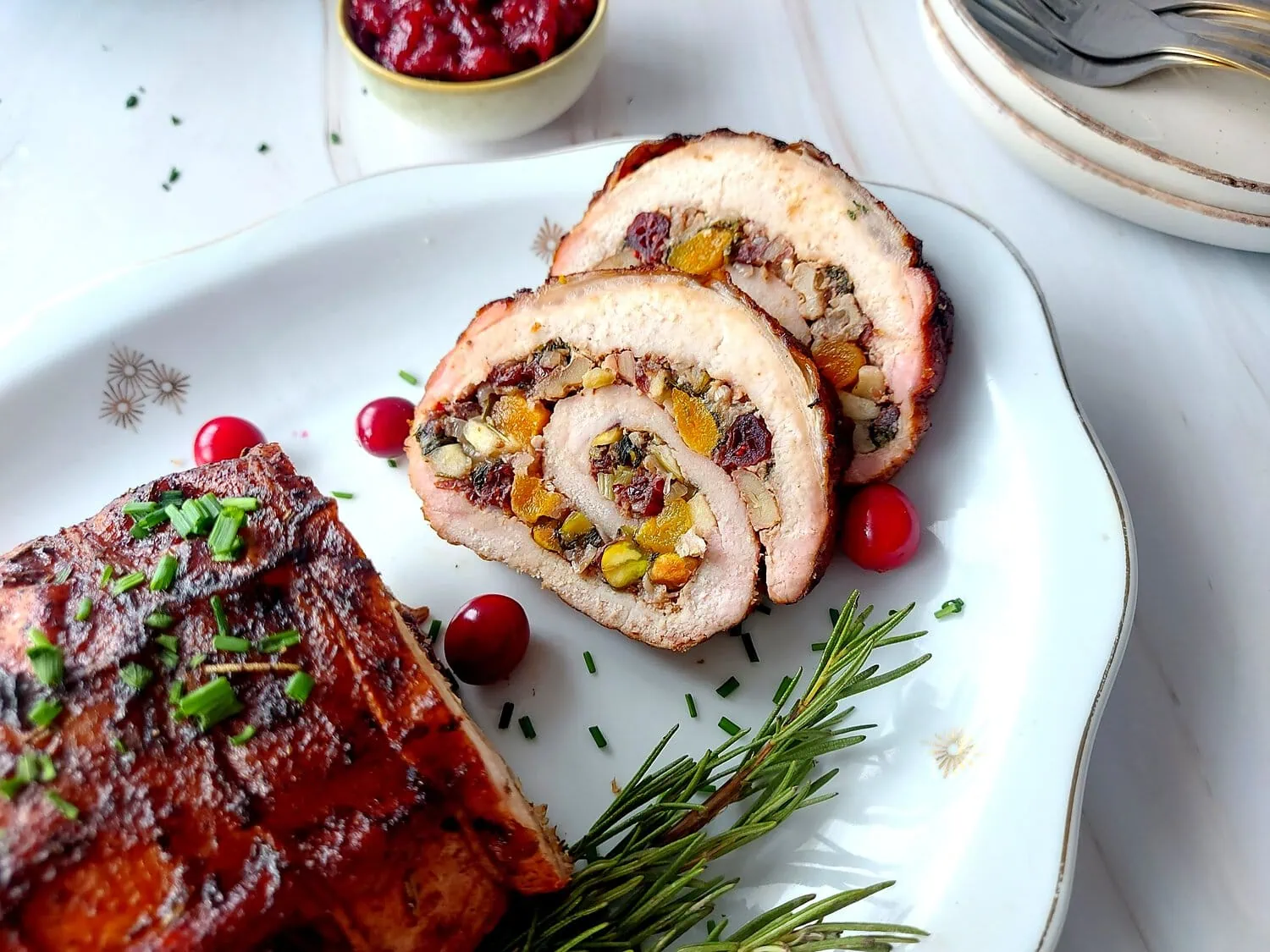
Once the stuffing mix is spread in an even layer, arrange the sliced dried apricots and cranberry sauce in diagonal lines across the pork. This way, every slice gets a bit of both, and it also creates a more beautiful presentation, with a pattern that changes from slice to slice instead of all looking the same.
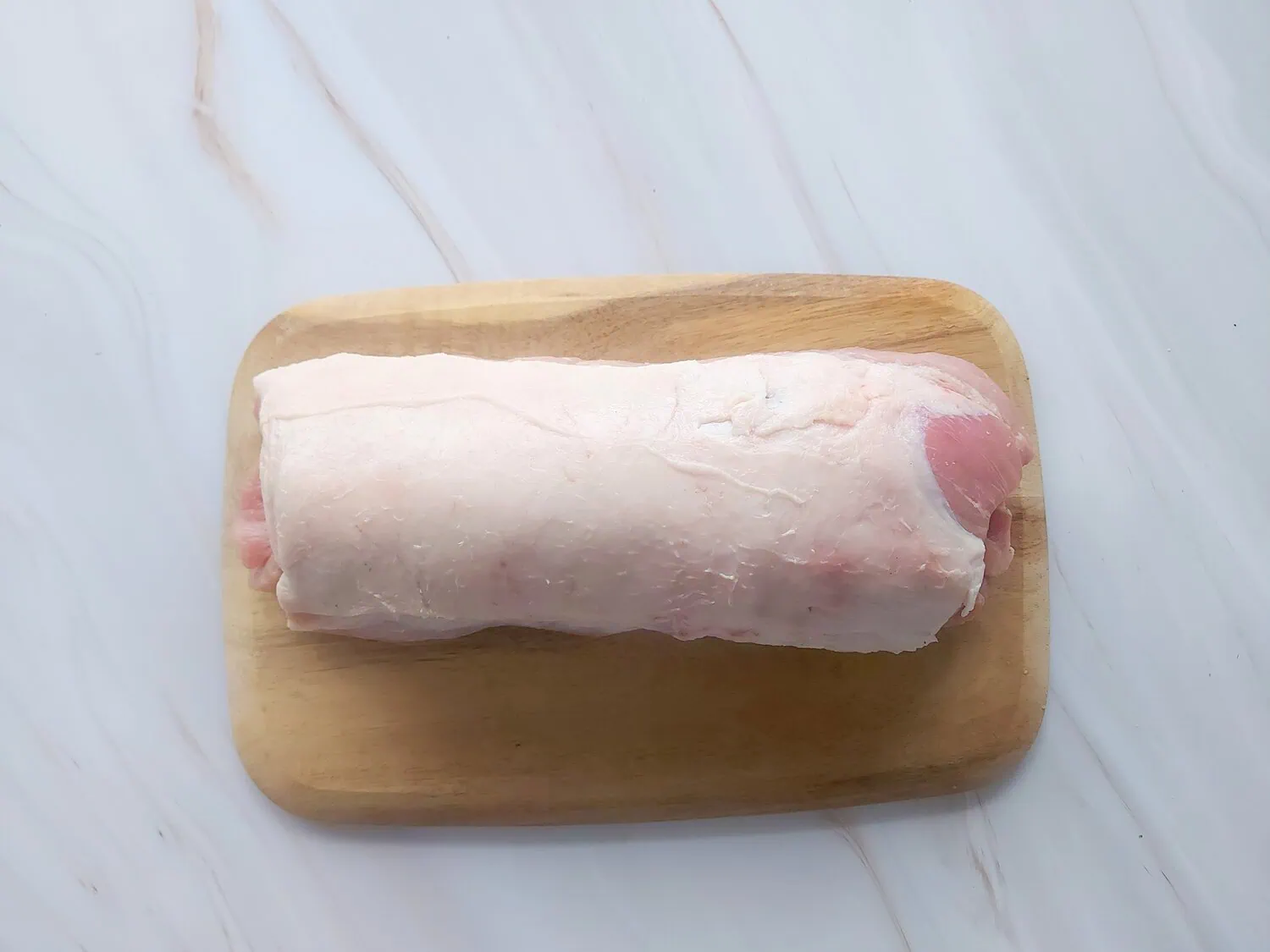
Begin rolling the pork loin from the side opposite the fat cap, finishing with the fat cap on the outside. Roll it tightly so the filling stays in place and the slices hold together when cut.

The finished pork loin should resemble a jelly roll, with the fat side facing up.
Step 5 – Tie the stuffed pork loin roulade
To keep the stuffing in place during cooking, secure the pork roll with kitchen twine. Use one long piece of twine without cutting it. Start by tying a firm loop around one end of the pork, leaving about 2 inches of twine hanging (you’ll use this at the end). Make sure the loop is snug but not so tight that the filling spills out.
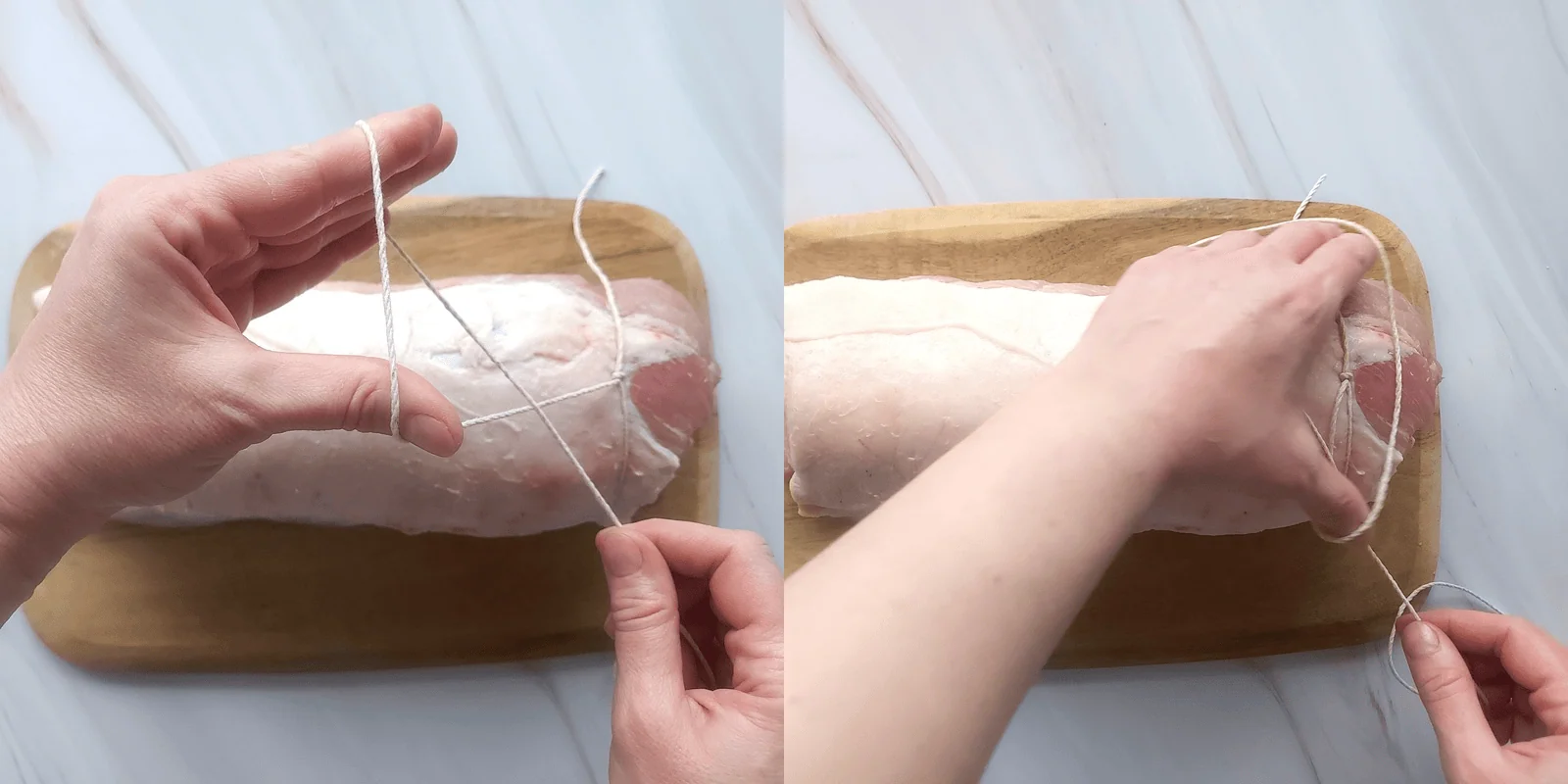
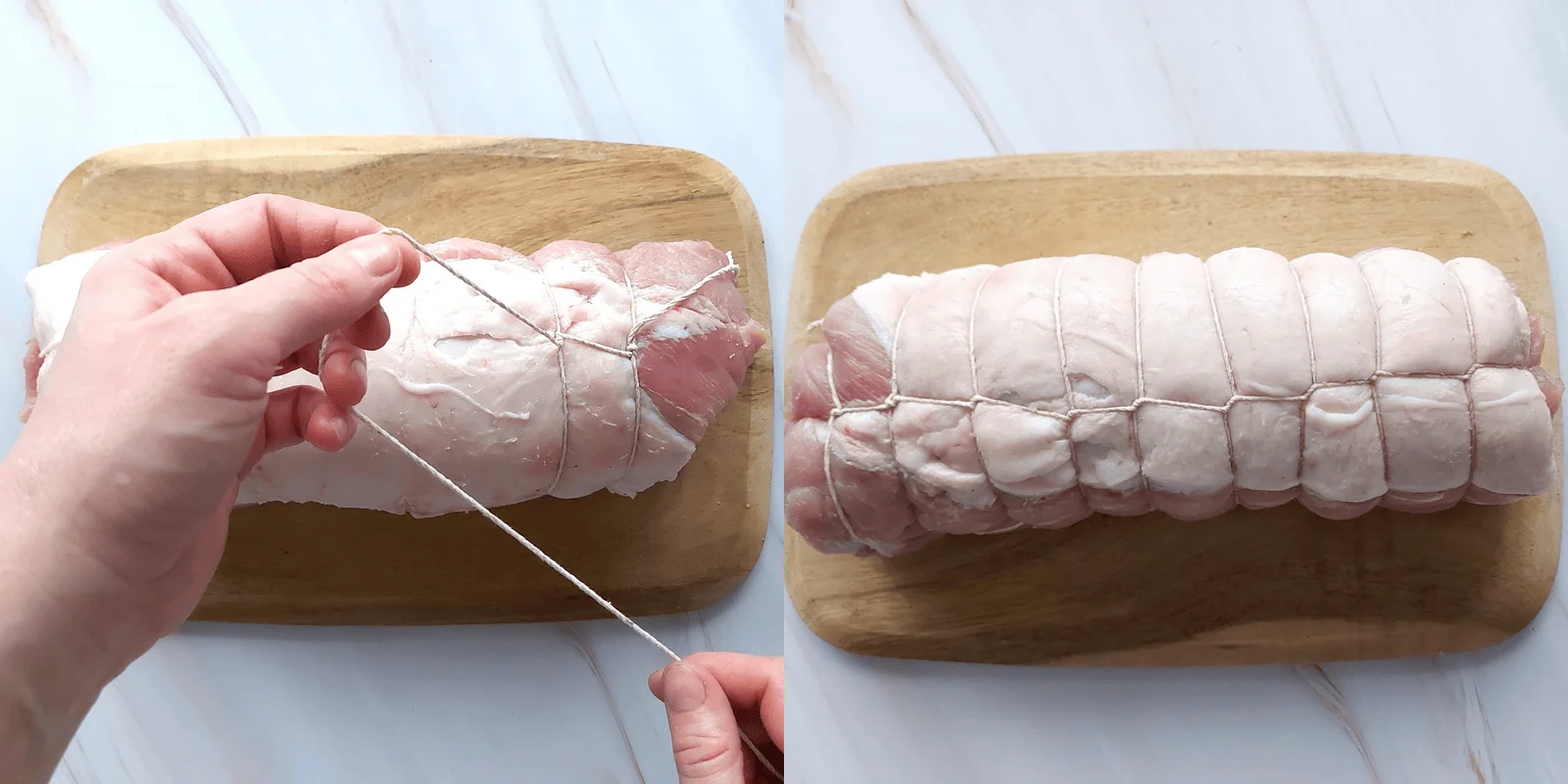
Continue tying by making loops around the pork at 1-inch intervals. Swirl the twine around your hand, slip it over the pork, then pull it up to tighten. When you reach the end, pass the twine around the final edge to secure it.
Cut the remaining twine so it’s about 2 times the length of the pork loin. Turn the roulade bottom-side up and use the twine to wrap twice around each loop to tighten the roll. Once you reach the starting point, pass the twine around the original 2-inch tail and tie tightly. Cut off any excess twine.
Pro tip: If you want to make the stuffed pork loin ahead, wrap it tightly in plastic wrap at this point and refrigerate until ready to cook.
Step 6 – Sear the pork loin
Preheat the oven to 375°F (190°C).
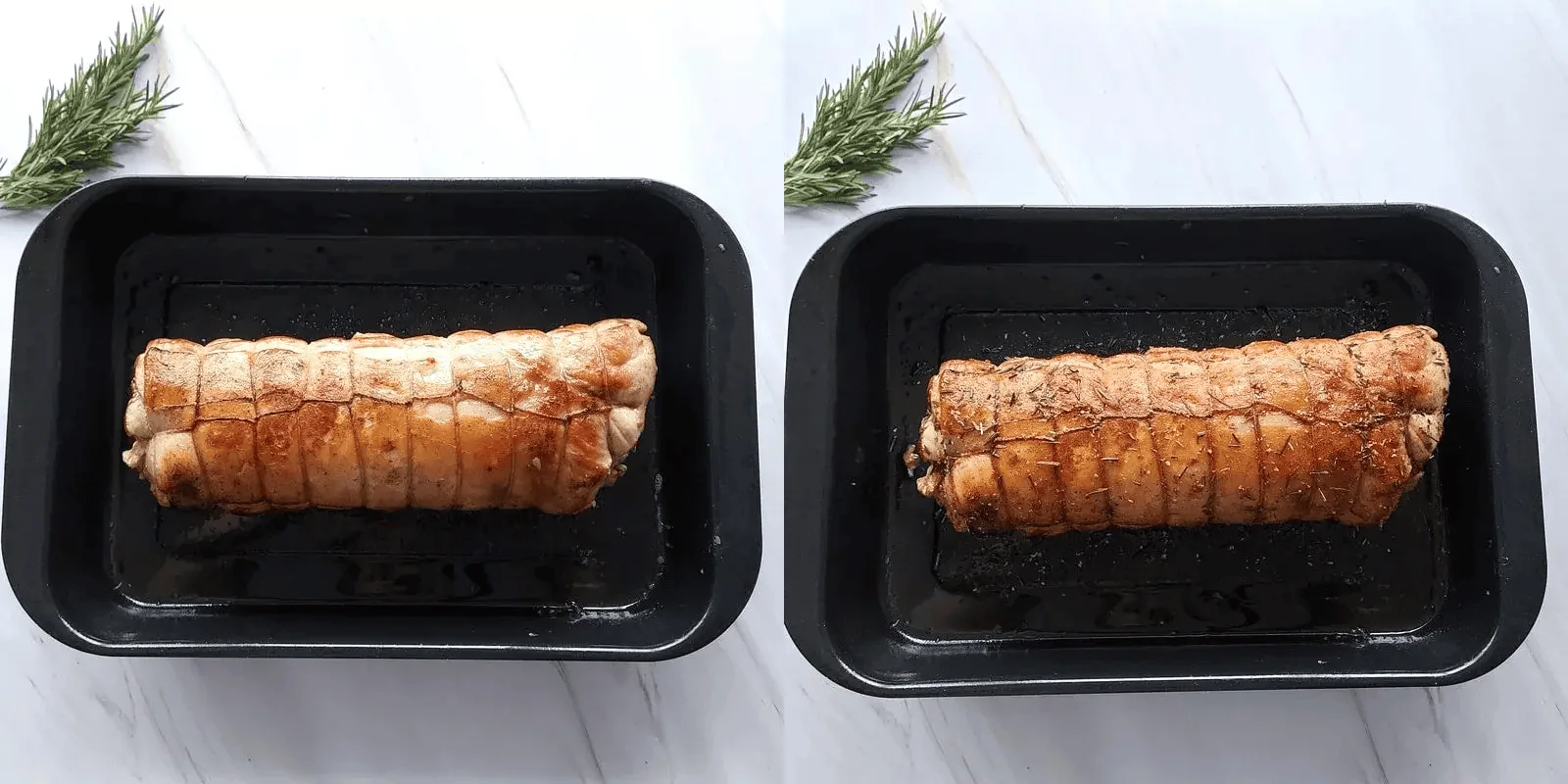
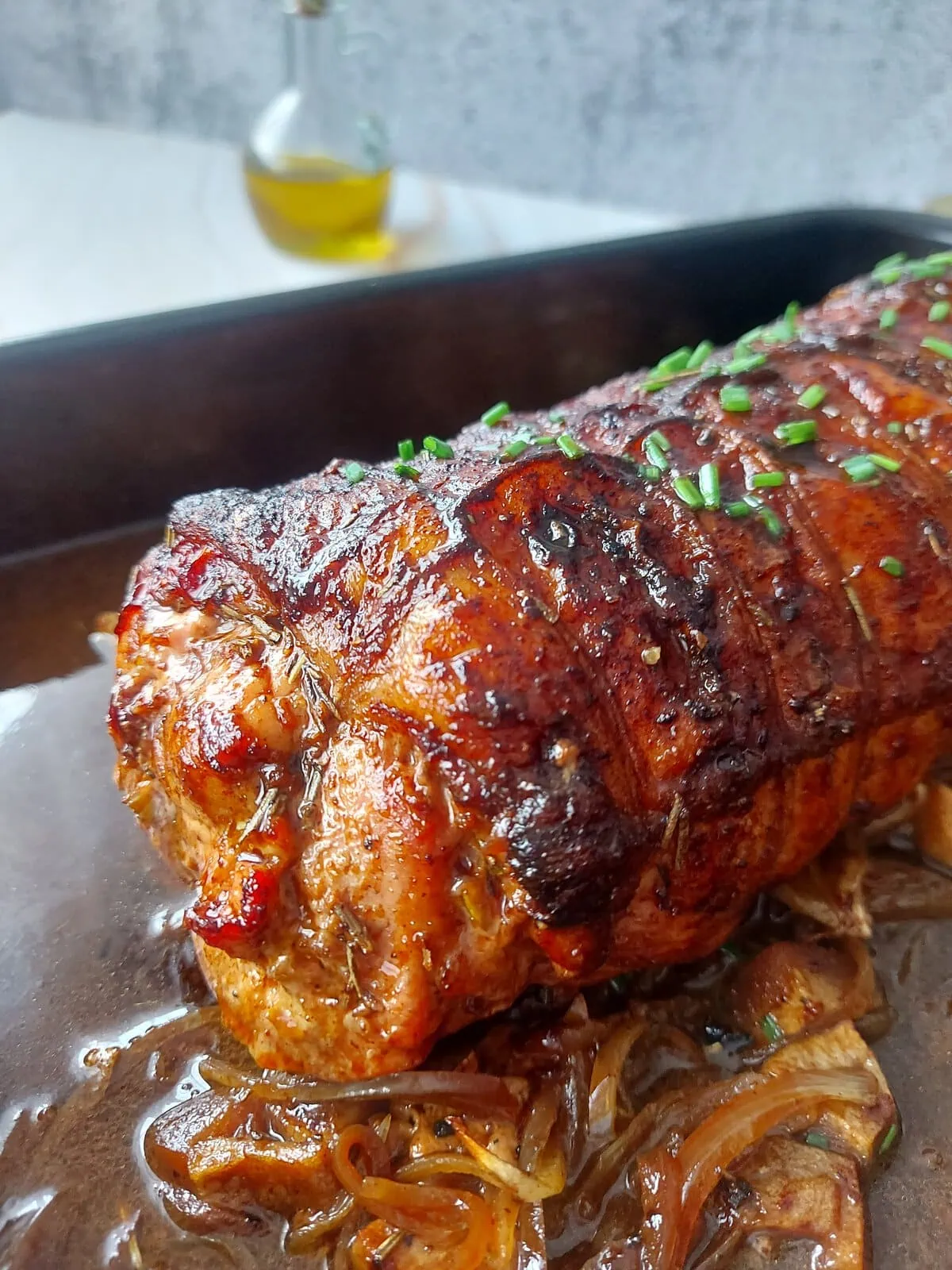
Preheat a roasting pan or a large skillet over medium-high heat and drizzle in 2-3 tablespoons of olive oil. Rub the roast with some olive oil. Add the pork loin to the pan, fat side down. Sear until golden brown, then turn it over. Continue turning every few minutes until the pork is nicely browned on all sides.
Once the pork loin is well seared, remove it from the heat and rub it evenly with the dry rub. Drizzle with 2 tablespoons of olive oil and gently massage it in, making sure the rosemary is coated so it doesn’t burn during roasting.
Step 7 – Prepare the bed for the pork loin
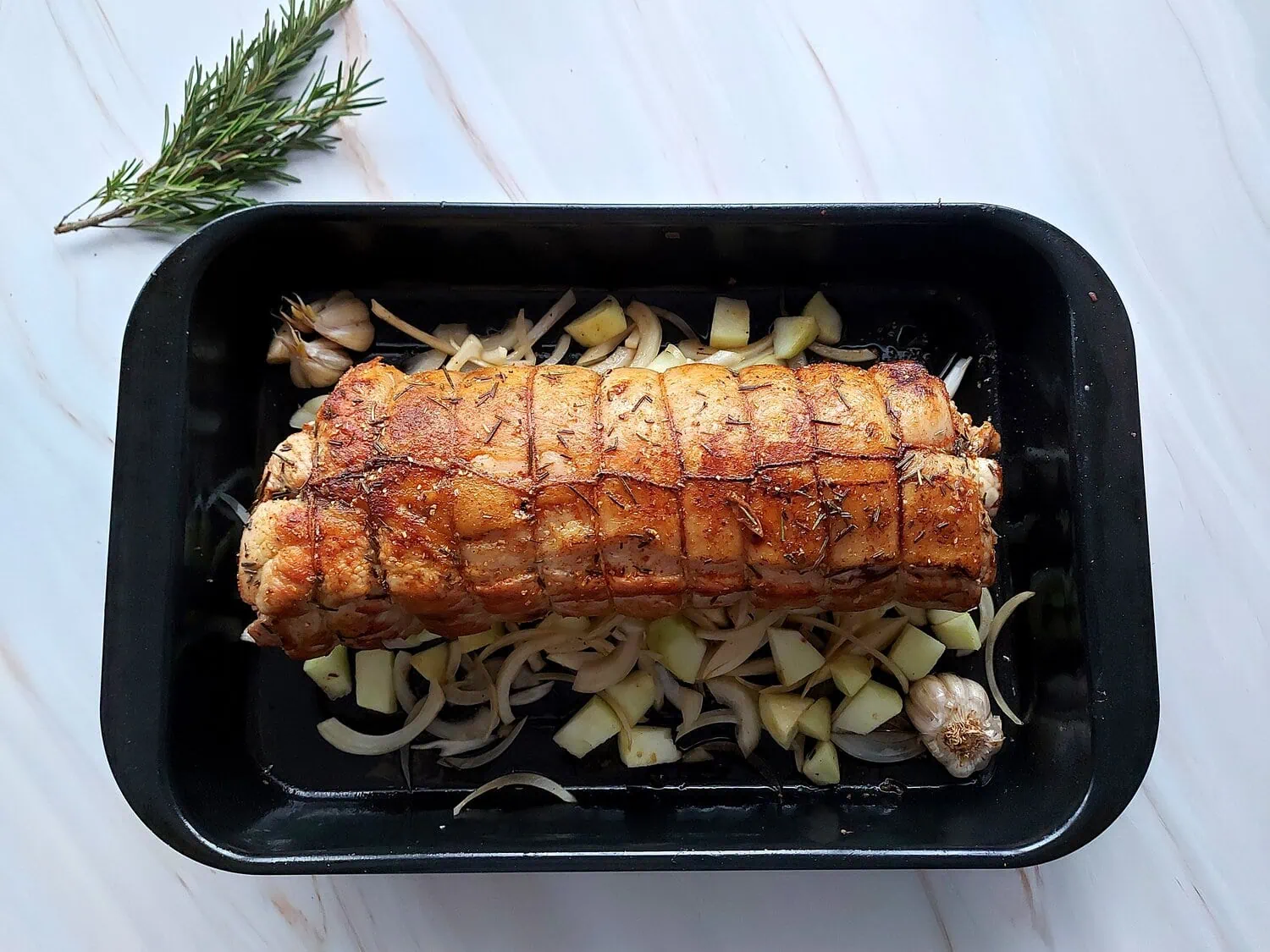
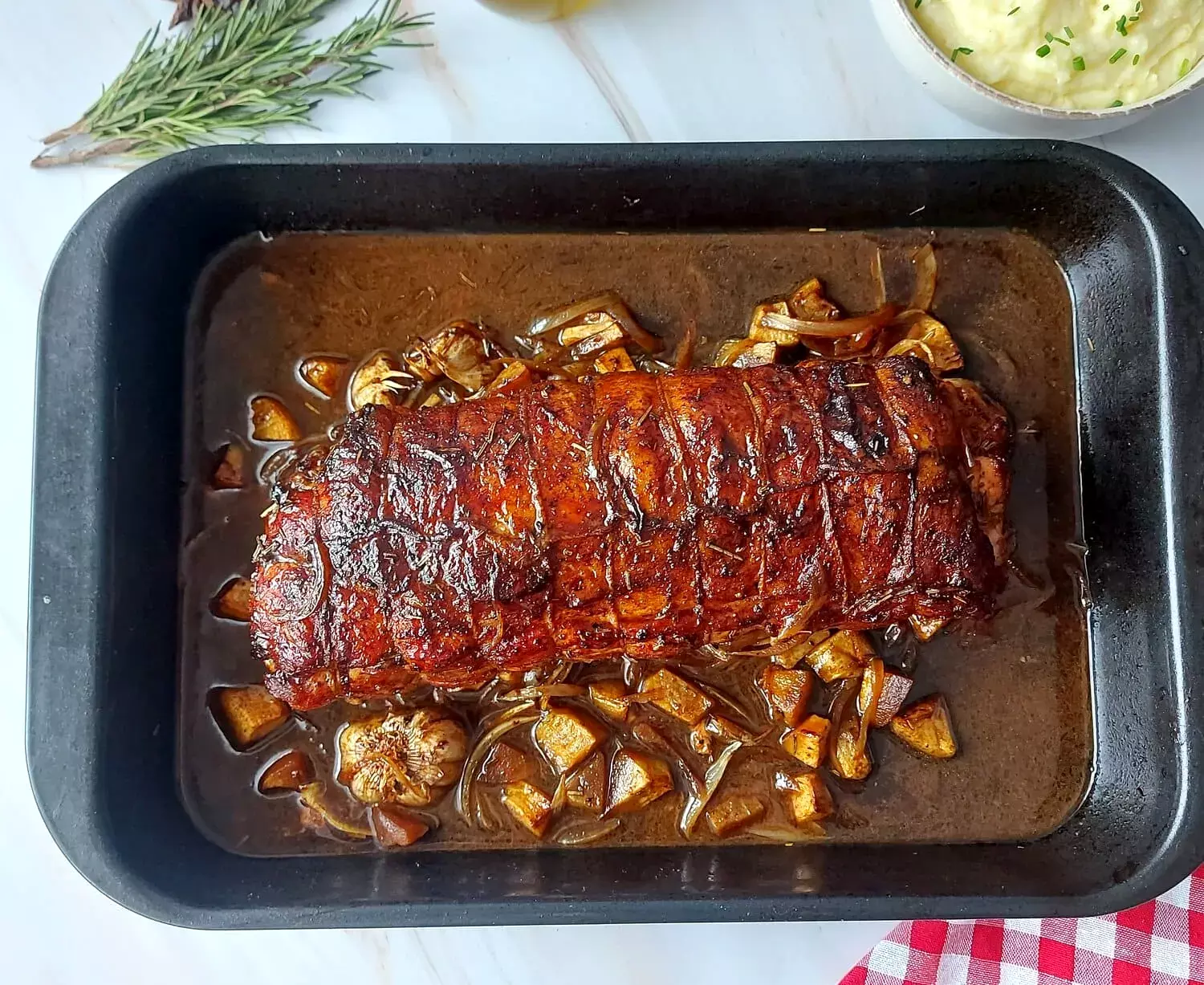
Prepare a bed for the roast so it doesn’t burn (you’ll also use this for the sauce later). Add the diced apple, sliced onion, garlic head cut in half (cut side down), apple cider, and butter to the pan.
Place the stuffed pork loin on top of the bed and transfer the baking dish to the oven.
Step 8 – Roast the stuffed pork loin
Roast the pork loin uncovered for about 1 hour and 15 minutes. If the top browns too quickly, tent it loosely with aluminum foil. During roasting, baste the pork 2–3 times with the pan juices to help it develop a beautiful golden color.
Begin checking for doneness after 45 minutes. The pork is done when a meat thermometer inserted into the center of the roast reads 145°F (63°C) for medium doneness. Be sure to insert the thermometer into the meat itself, not the stuffing, for the most accurate reading.
For best results, remove the stuffed pork loin from the oven when it is 5–10°F (3–6°C) below your desired doneness, as the temperature will continue to rise while resting (carryover cooking). For medium doneness (145°F), this means removing the roast at about 135–140°F, then resting it for 15–30 minutes.
Once done, remove the pork loin from the oven and baste it well with the pan juices. Transfer the stuffed pork loin to a cutting board, wrap it loosely in foil, and let it rest for 15–30 minutes before slicing. Resting is essential for keeping the pork juicy and preventing it from drying out.
Step 9 – Remove the kitchen twine and slice
I like to remove the kitchen twine as soon as the roast comes out of the oven. If it sits too long, the twine can become embedded in the meat, and you may end up pulling off bits of pork along with the string.

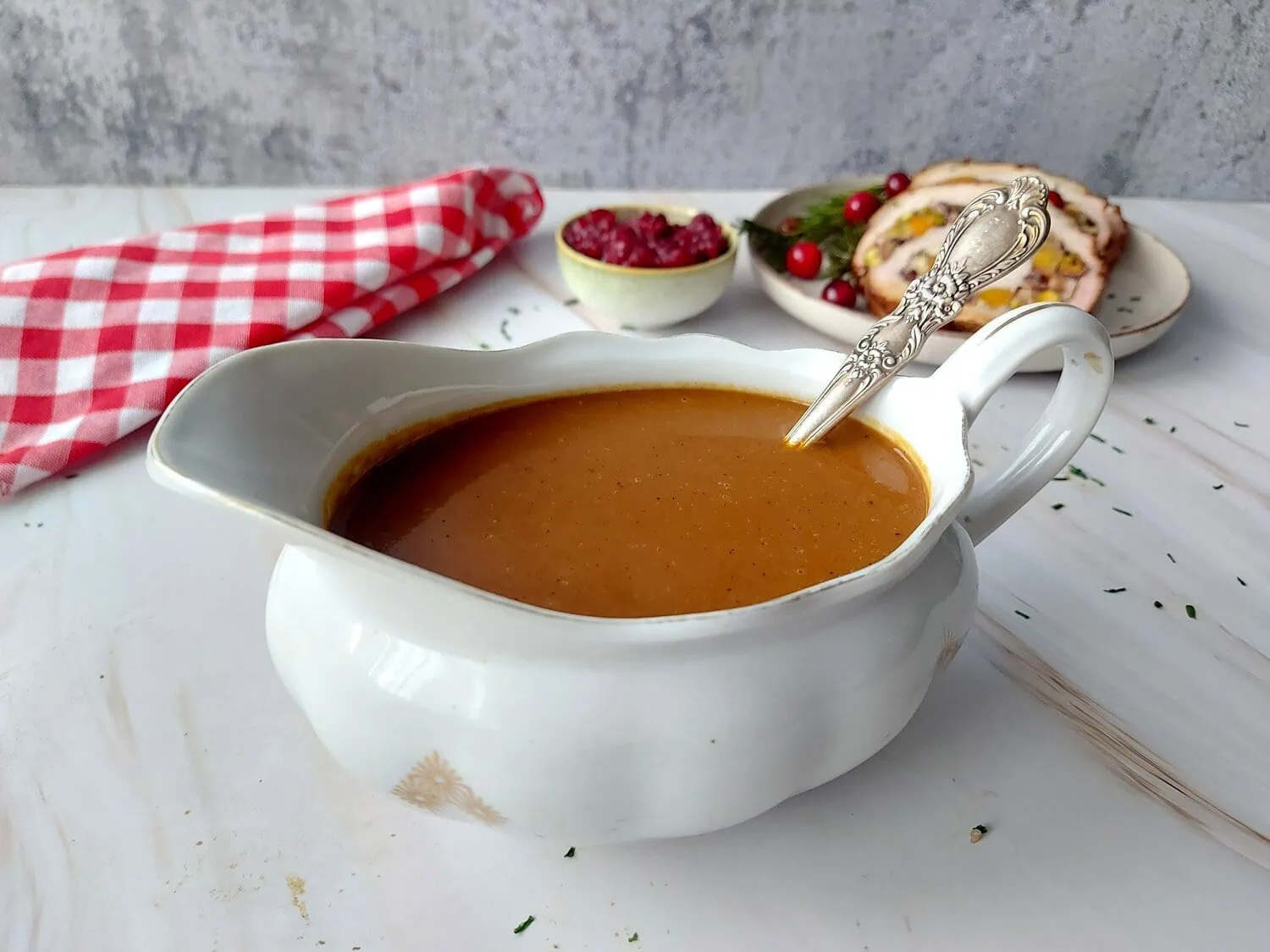
Step 10 – Make the gravy
This is the easiest gravy you can make. Start by removing any excess fat that floats on top of the drippings. I skipped this step, as there wasn’t too much fat in my pan. And whatever was there just added richness and helped the sauce come together beautifully.
Transfer the roasted apples, onions, and pan juices into a blender. Squeeze the soft, roasted garlic cloves out of their skins and add them to the blender as well. Blend until smooth and creamy.
If you prefer a finer, more refined sauce, strain it through a fine mesh strainer.
Taste and adjust seasoning if needed. My sauce was perfect as it was, and it didn’t need anything else.
Pro tip: Depending on the flavor boost you are looking for, you can adjust the taste by adding more mustard, apple cider, thyme, rosemary, salt, or pepper.
Step 11 – Slice, serve, and enjoy
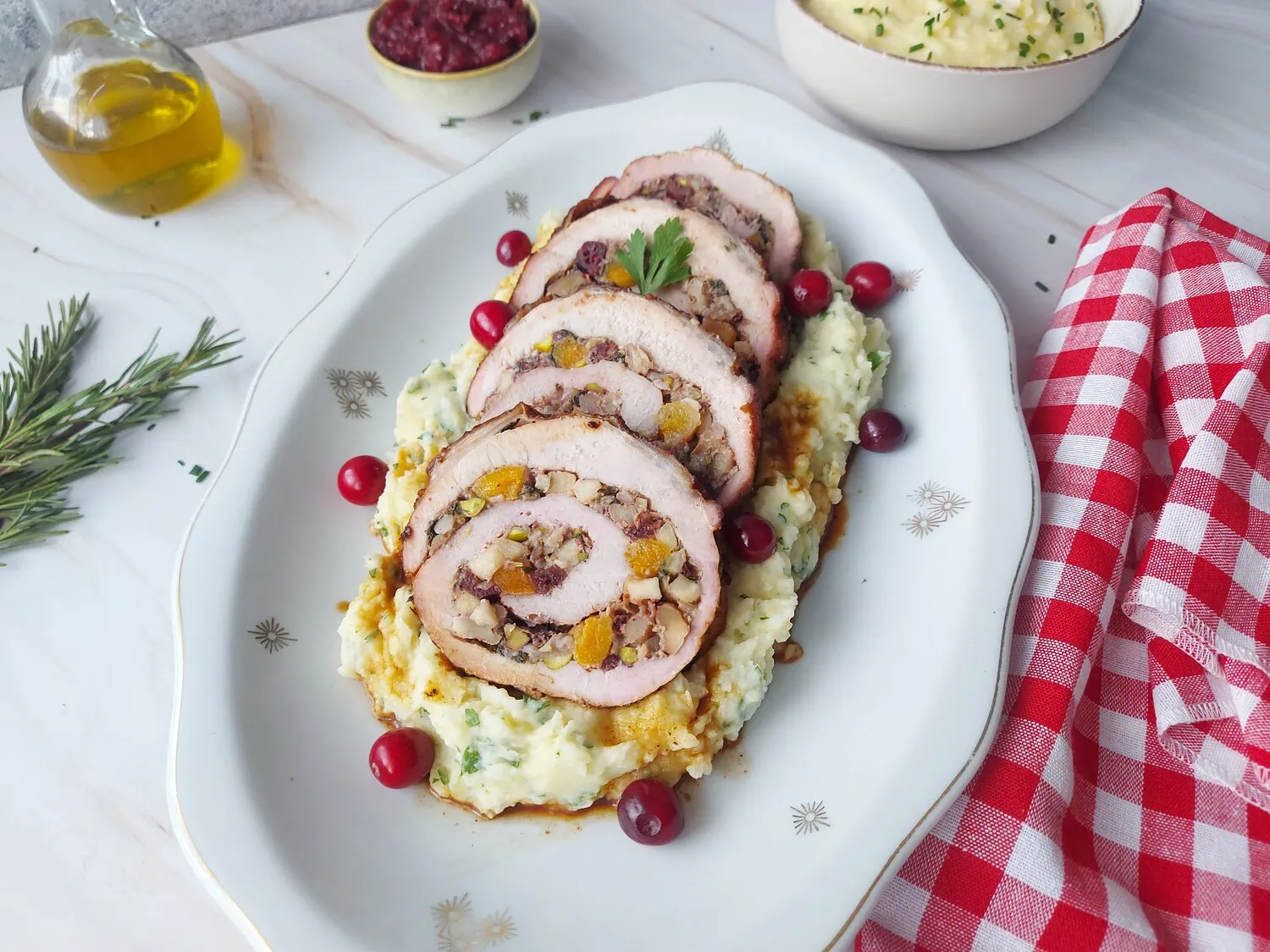
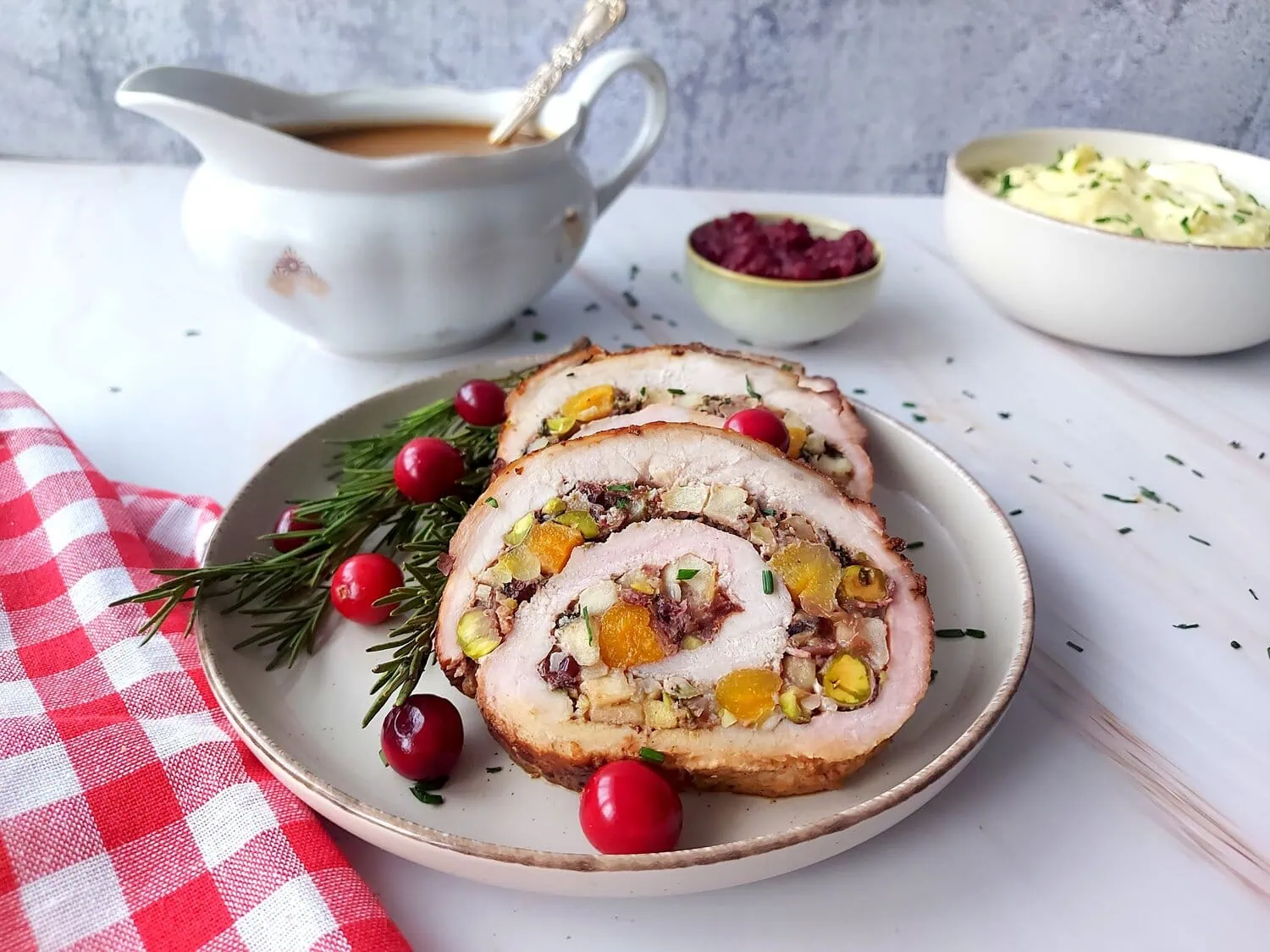
After the pork has rested, slice it into ½-inch-thick slices using a very sharp knife. Serve with your favorite side dishes and a generous amount of gravy. I love pairing it with mashed potatoes and my Roasted Asparagus with Lemon. Enjoy!
Roasting Times by Doneness
The roasting times below are a general guide for a 1.5 kg stuffed pork loin roasted at 375°F (190°C). Keep in mind that oven temperatures can vary, so checking the internal temperature is best.
Medium: 145°F (63°C) after resting
Roast for 1 hour 5 minutes – 1 hour 15 minutesMedium-Well: 150–155°F (65–68°C) after resting
Roast for 1 hour 15 minutes – 1 hour 25 minutesWell-Done: 160°F+ (71°C+) after resting
Roast for 1 hour 25 minutes – 1 hour 40 minutes
How to Tell If the Pork Loin Is Done Without a Thermometer
If you don’t have a meat thermometer, there are a few visual and tactile cues you can use. Carefully press the center of the roast with your finger or tongs — it should feel firm but still slightly springy, not soft or mushy. If it feels very hard, it’s likely overcooked.
You can also check the juices by making a small cut near the center of the roast. The juices should run clear or very lightly pink, not red. A slight blush is perfectly fine and will fade as the pork rests.
Finally, when sliced after resting, the pork should be juicy and pale pink in the center, not gray or dry. When in doubt, it’s better to pull the pork a little early and let it finish cooking as it rests.
Tips for The Best Stuffed Pork Loin
– For an impressive stuffed pork loin, the rolling pattern really matters. Take your time when butterflying and rolling the pork loin — this step is what defines the final look of the slices. Don’t rush it.
– Pork loin is a lean cut of meat and can dry out easily if overcooked. That’s why it’s best to leave the fat cap on. As it cooks, the fat slowly renders and bastes the roulade, helping keep the pork moist and flavorful throughout the roasting process.
– Always use a meat thermometer to check for doneness. Remove the pork from the oven when it’s about 5-10°F below your target temperature. For example, for medium doneness (145°F / 63°C), take the pork out at around 135-140°F (57-60°C). The temperature will continue to rise as it rests due to carryover cooking.
– Resting is essential for a juicy pork loin. Let the stuffed pork loin rest for 15–30 minutes after cooking. Resting allows the juices to redistribute throughout the meat instead of spilling out when sliced, ensuring a moist and tender result. This is one of the most important steps for a successful roast.
– To build a beautiful crust, baste the pork loin with the pan juices after the first 20 minutes of roasting, then continue basting every 15 minutes or so.
Make Ahead and Storage
Make Ahead
This Cranberry Apple Stuffed Pork Loin is perfect for the holiday season and entertaining, and can be prepared ahead of time. The pork can be fully assembled, rolled, and tied up to 24 hours in advance. Wrap it tightly in plastic wrap and refrigerate until ready to cook.
When ready to roast, remove the pork from the refrigerator about 30 minutes before cooking to allow it to come to room temperature for more even roasting.
The stuffing can be prepared 1–2 days ahead and stored in an airtight container in the refrigerator. Let it cool completely before refrigerating.
Storage
Store leftover stuffed pork loin in an airtight container in the refrigerator for up to 3–4 days. For best results, store slices with a little of the pan sauce to help keep the meat moist.
Reheating
Reheat leftovers gently to avoid drying out the pork. Cover and warm in a 325°F (165°C) oven until heated through, or microwave in short intervals with a spoonful of sauce.
Freezing
The fully cooked pork loin can be frozen for up to 2-3 months. Once cooled, wrap the full roast or slices tightly in plastic wrap and in two layers of foil, then place them in a freezer-safe container or bag. Thaw overnight in the refrigerator and reheat gently with a little sauce to prevent drying out.
What are the best side dishes to serve with stuffed pork loin?
Roast pork pairs beautifully with a variety of side dishes. Because pork loin is rich yet lean, it works especially well with mashed or creamy potatoes, roasted vegetables, sautéed greens, grains, and simple dishes that complement the flavors. Here are a few sides that will round out the plate perfectly:
Roasted Asparagus with Lemon – a bright, fresh vegetable side that pairs beautifully with roast pork
Golden Roast Potatoes with Rosemary and Garlic – crispy roasted potatoes with herbs and garlic, perfect alongside pork
Grilled Mediterranean Vegetable Skewers Recipe – colorful grilled vegetables with Mediterranean flavors
Mom’s Creamy Potato Salad Recipe – a classic creamy potato salad for family-style meals
Authentic 3 Ingredient Fettuccine Alfredo (no cream) – a simple, creamy pasta side made without cream
If you’re planning a holiday or special occasion menu, consider serving this stuffed pork loin as the main course, with a charcuterie board to kick things off and my Deviled Eggs Recipe with Bacon (Unexpected Twist!) as a classic appetizer. It’s an easy way to build a balanced, festive meal without overcomplicating things.
Frequently Asked Questions:
What internal temperature should stuffed pork loin be cooked to?
A stuffed pork loin should be cooked to an internal temperature of 145°F (63°C) in the center of the roast, after resting, for medium doneness. Always insert the meat thermometer into the pork itself, not the stuffing, for the most accurate reading. After removing it from the oven, let the pork loin rest. This is crucial. Since the temperature rises during resting due to carryover cooking, you should take out the pork loin from the oven once it reaches an internal temperature of 135-140°F (57-60°C). Check the section above for “Roasting Times by Doneness”.
How do I keep stuffed pork loin from drying out?
To keep a stuffed pork loin juicy, avoid overcooking it and always use a meat thermometer. Leaving the fat cap on helps naturally baste the pork as it roasts, and resting the meat for 15–30 minutes after cooking allows the juices to redistribute instead of running out when sliced.
Does the size of the pork loin affect cooking time?
Yes, cooking time depends on the size of the pork loin. This recipe is based on a 3.3-pound (1.5 kg pork loin). Smaller loins will cook faster, so begin checking the internal temperature earlier to avoid overcooking. Always rely on temperature rather than time alone.
Can I make stuffed pork loin ahead of time?
Yes, stuffed pork loin is a great make-ahead dish. It can be fully assembled, rolled, and tied up to 24 hours in advance (make Steps 1 to 5 above), then wrapped tightly and refrigerated. Remove it from the refrigerator about 30 minutes before roasting for more even cooking.
How long should I let a stuffed pork loin rest before slicing?
A stuffed pork loin should rest for 15–30 minutes after roasting. Resting allows the juices to redistribute throughout the meat, ensuring moist slices. Cutting too soon can cause the juices to escape, resulting in drier pork.
How do I know when stuffed pork loin is done without a thermometer?
Without a thermometer, the pork should feel firm but slightly springy when pressed. The juices should run mostly clear (cut somewhere not visible), and the center should be juicy with a faint blush of pink after resting. If unsure, it’s better to remove the pork slightly early and allow it to finish cooking as it rests.
Can I cook the stuffed pork loin without twine?
Yes, you can cook the stuffed pork loin without twine by using substitutes like toothpicks or wooden skewers, or by sewing it shut with butcher’s floss. However, twine is recommended for the best results as it keeps the stuffing tightly in place and secure. Toothpicks are the easiest alternative to hold the seam closed during cooking.
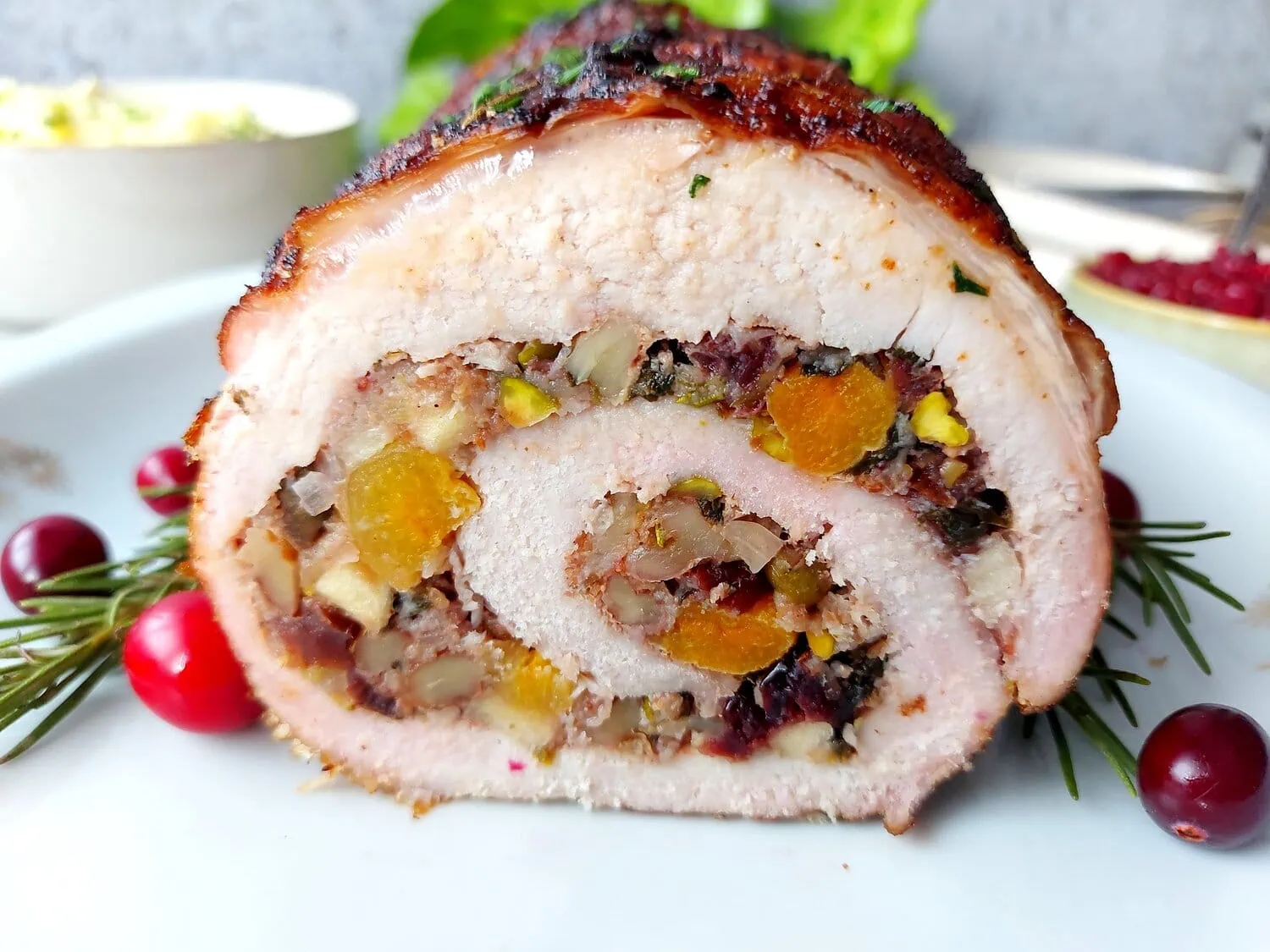
This Cranberry Apple Stuffed Pork Loin is the kind of recipe you make when you want to put something truly special on the table. It’s festive, elegant, and full of delicious flavors. And while it does take a bit of time and patience, every step pays off in the final result.
If you decide to make this stuffed pork loin, let me know how it goes in the comments below. I’d love to hear if it was part of a holiday meal or a special gathering, and what sides you served alongside it!
Other recipes you may like
- Greek Slow Roasted Leg of Lamb (Fall Off the Bone!)
- Roasted Asparagus with Lemon (Ridiculously Easy)
- What to Put on a Charcuterie Board (Tips and Tricks)
- Creamy Cucumber and Tomato Salad Recipe

Cranberry Apple Stuffed Pork Loin (Festive & Refined)
Ingredients
PORK LOIN
- 1 x 3 to 4 pound (1.4-1.8 kg) boneless pork loin
- salt to taste
FOR FILLING
- 4-5 slices smoked bacon (finely diced)
- 2 TBSP butter
- ½ cup finely diced shallots (1 shallot)
- 3 TBSP finely diced celery
- 7-8 garlic cloves (pressed)
- 3 TBSP brandy
- 1 ½ cups Granny Smith apples (peeled and diced)
- 2 cups spinach (approx. 100 g)
- ¼ cup dried cranberries
- ⅓ cup dried apricots (halved, or chopped)
- ⅓ cup toasted pistachios (roughly chopped)
- ¼ cup toasted walnuts (roughly chopped)
- ½ cup Panko breadcrumbs
- 2-3 TBSP apple cider (or apple juice)
- ½ TBSP yellow mustard
- 1 tsp brown sugar
- 2 tsp fresh rosemary (minced)
- 1 tsp fresh sage (minced)
- ¼ tsp nutmeg
- ¼ tsp black pepper
- ½ tsp salt
FOR DRY RUB
- ½ tsp garlic powder
- ½ tsp onion powder
- 1 tsp smoked paprika
- 1½ tsp salt
- 1 tsp freshly ground black pepper
- ½ tsp dried rosemary
- ¼ tsp mustard powder
FOR ROASTING PAN
- 1 large Granny Smith apple (peeled and diced)
- 1 large onion (sliced)
- 1 garlic head (cut in half)
- 1 TBSP butter
- 1½ cup apple cider
- 1 cup chicken stock
CRANBERRY RIBBONS
- 3-4 TBSP cranberry sauce
Instructions
PREPARING THE FILLING AND THE DRY RUB
- In a small bowl mix all of the dry rub ingredients. Set aside.
- Heat 2 tablespoons of oil in a pan and cook the bacon until lightly fragrant but not crisp. Add the shallots and celery; sauté until soft and translucent. Stir in 1 tablespoon of butter, add the garlic, and sauté until fragrant. Then, add the brandy and cook for about 1 minute until the brandy has evaporated. Finally, add the spinach and sauté for 15-20 seconds, just until wilted.
- Transfer the mixture to a large bowl and add the remaining stuffing ingredients: apples, dried cranberries (do not add the dried apricots yet), pistachios, walnuts, bacon bits, mustard, sugar, nutmeg, fresh rosemary, fresh sage, breadcrumbs, and apple cider. Season with salt and pepper to taste, then let the filling cool completely.Note 1: If you prefer a finer-textured filling, you can pulse the apple mixture in a food processor using 1-second pulses until you reach the desired texture. I personally prefer the chunkier texture, which I find more visually appealing.Note 2: If you don't want to make the lines of dried apricots and cranberry sauce, simply chop and add them to the filling, along with all the other ingredients.
PREPARING THE PORK LOIN
- Place the pork loin, fat cap down, on a cutting board. Using a long sharp knife, start your first cut lengthwise along one side of the pork, holding the knife at about a 45-degree angle and slicing downward. Cut slowly and stop when you’re about ½ to ⅓ inch from the bottom, making sure you don’t cut all the way through.
- From there, turn your knife so it’s almost parallel to the cutting board and continue making long, steady cuts, gently “rolling out” the pork loin as you go until it opens into one long sheet. Try not to cut all the way through, but if it happens, don’t worry — it’s totally fine. Just keep going carefully, and the pork will still roll up nicely.
- Your goal is to create one long, flat piece of pork that has an even thickness - about ½ to ⅓ inch thick. A thinner cut will give you a longer sheet and a larger, more dramatic spiral once rolled, while a thicker cut will result in a shorter sheet and a tighter roll. Taking your time here really pays off, because this step is what gives the pork loin that beautiful, swirled look when sliced.Pro Tip: If you’re nervous, pause after every few inches of cutting, gently open the pork to check thickness, and adjust as you go - slow and steady works best here.
- To flatten the pork loin, place it between two sheets of plastic wrap. Use a meat mallet to gently pound it until it’s a somewhat even thickness all over. Remove the plastic wrap and season with salt and pepper.
STUFFING, ROLLING, AND TYING
- Transfer the filling to the butterflied pork loin, spreading it into an even layer across the meat. Leave a 1-inch border all around to prevent it from spilling out. On the fat cap side, where you'll finish the rolling, leave a wider 2-inch border.
- Arrange the sliced dried apricots and cranberry sauce in diagonal lines across the pork to create a beautiful presentation when sliced.
- Begin rolling the pork loin from the side opposite the fat cap, finishing with the fat cap on the outside. Roll it tightly so the filling stays in place and the slices hold together when cut. The finished pork loin should resemble a jelly roll, with the fat side facing up.
- To keep the stuffing in place during cooking, secure the pork roll with kitchen twine. Use one long piece of twine without cutting it. Start by tying a firm loop around one end of the pork, leaving about 2 inches of twine hanging (you’ll use this at the end). Make sure the loop is snug but not so tight that the filling spills out.
- Continue tying by making loops around the pork at 1-inch intervals. Swirl the twine around your hand, slip it over the pork, then pull it up to tighten. When you reach the end, pass the twine around the final edge to secure it.
- Cut the remaining twine so it’s about 2 times the length of the pork loin. Turn the roulade bottom-side up and use the twine to wrap twice around each loop to tighten the roll. Once you reach the starting point, pass the twine around the original 2-inch tail and tie tightly. Cut off any excess twine.Pro tip: If you want to make the stuffed pork loin ahead, wrap it tightly in plastic wrap at this point and refrigerate until ready to cook.
SEARING THE PORK LOIN
- Preheat the oven to 375°F (190°C).
- Preheat a roasting pan over medium-high heat and drizzle in 2-3 tablespoons of olive oil. Rub the roast with some olive oil. Add the pork loin to the pan, fat side down. Sear until golden brown, then turn it over. Continue turning every few minutes until the pork is nicely browned on all sides.
- Once the pork loin is well seared, remove from the heat and rub it evenly with the dry rub. Drizzle with 2 tablespoons of olive oil and gently massage it in, making sure the rosemary is coated so it doesn’t burn during roasting.
ROASTING THE PORK LOIN
- Prepare a bed for the roast so it doesn’t burn (you’ll also use this for the sauce later). Add the diced apple, sliced onion, garlic head cut in half (cut side down), apple cider, chicken stock, and butter to the pan.
- Place the stuffed pork loin on top of the bed and transfer the baking dish to the oven.
- Roast the pork loin uncovered for about 1 hour and 15 minutes. If the top browns too quickly, tent it loosely with aluminum foil. After the first 20 minutes of roasting, keep basting the pork every 10 minutes with the pan juices to help it develop a beautiful golden color.
- Begin checking for doneness after 45 minutes. A meat thermometer inserted into the center of the roast should read 145°F (63°C) for medium doneness. Be sure to insert the thermometer into the meat itself, not the stuffing, for the most accurate reading.For best results, remove the stuffed pork loin from the oven when it is 5–10°F (3–6°C) below your desired doneness, as the temperature will continue to rise while resting (carryover cooking). For medium doneness (145°F), this means removing the roast at about 135–140°F, then resting it for 15–30 minutes.
- Once done, remove the pork loin from the oven and baste it well with the pan juices. Transfer the stuffed pork loin to a cutting board, wrap it loosely in foil, and let it rest for 15–30 minutes before slicing. The internal temperature will continue to rise slightly as it rests. Resting is essential for keeping the pork juicy and preventing it from drying out.
- Remove the kitchen twine as soon as you take out the pork from the oven, or you may end up pulling off bits of pork along with the string.
MAKING THE GRAVY
- Remove any excess fat that floats on top of the drippings, if you need to.
- Transfer the roasted apples, onions, and pan juices into a blender. Squeeze the soft, roasted garlic cloves out of their skins and add them to the blender as well. Blend until smooth and creamy. If you prefer a finer, more refined sauce, strain it through a fine mesh strainer.
- Taste and adjust seasoning if needed. My sauce didn't need any.Pro tip: Depending on the flavor boost you are looking for, you can adjust the taste by adding more mustard, apple cider, thyme, rosemary, salt, or pepper.
SLICE AND SERVE
- After the pork has rested, slice it into ½-inch-thick slices using a very sharp knife. Serve with your favorite side dishes and plenty of gravy. Enjoy!
Notes

Leave a Reply